Application
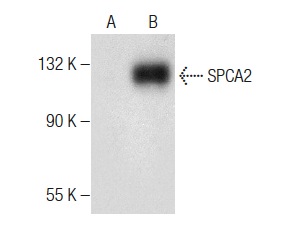
Western blot analysis of SPCA2 expression in non-transfected: (A) and human SPCA2 transfected: (B) 293T whole cell lysates.| Product Name | SPCA1/2 Antibody (H-110) |
|---|---|
| Antibody Type | Primary Antibodies |
| Modification Notes | The family of P-type Ca2+-transport ATPases is made up of three subfamilies: sarco(endo)plasmic-reticulum Ca2+ ATPases (SERCA), plasma- membrane Ca2+ ATPases (PMCA), and secretory-pathway Ca2+ ATPases (SPCA). The SPCA1 protein (encoded for by the ATP2C1 gene) is a Ca2+/ Mn2+-transport ATPase. It localizes to the Golgi apparatus and, together with SERCA2, is responsible for the ionic milieu in the Golgi lumen. Defects in the gene that encodes SPCA1 are the cause of Hailey-Hailey disease, an autosomal dominant disorder characterized by persistent blisters and acantholysis of the epidermis. SPCA2 (encoded by the ATP2C2 gene) also localizes to the Golgi apparatus and has a higher enzymatic turnover rate than that of SPCA1 while having a high affinity for cytosolic Ca2+. The enzymatic properties of the human SPCA2 enzyme and the restriction of its tissue expression to the gastrointestinal and respiratory tracts, prostate, thyroid, salivary, and mammary glands may, in principle, define a Ca2+-ATPase pump with a specific physiological role in secretory cells. |
| Clonality | Polyclonal |
|---|---|
| Isotype | IgG |
| Host Species | Rabbit |
| Tested Applications | WBIPIFELISA |
| recommended for detection of SPCA1 and SPCA2 of mouse, rat and human origin by WB, IP, IF and ELISA also reactive with additional species, including equine, canine, bovine and porcine | |
| Species Reactivity | HumanMouseRat |
| Concentration | 1mg/ml |
| Purification | Affinity purified |
| Alternative Names | epitope corresponding to amino acids 711-820 mapping near the C-terminus of SPCA2 of human origin |
|---|---|
| Tissue Specificity | epitope corresponding to amino acids 711-820 mapping near the C-terminus of SPCA2 of human origin |
| Entrez Gene | 9914 |
|---|
Application
Western blot analysis of SPCA2 expression in non-transfected: (A) and human SPCA2 transfected: (B) 293T whole cell lysates.| Application Notes | recommended for detection of SPCA1 and SPCA2 of mouse, rat and human origin by WB, IP, IF and ELISA also reactive with additional species, including equine, canine, bovine and porcine |
|---|
| Form | Liquid |
|---|---|
| Storage Instructions | For short-term storage, store at 4° C. For long-term storage, aliquot and store at -20ºC or below. Avoid multiple freeze-thaw cycles. |
| Storage Buffer | phosphate buffered saline , pH 7.4, 150mM NaCl, 0.02% sodium azide and 50% glycerol. |


