Application
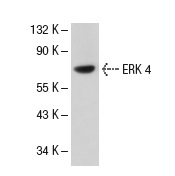
Western blot analysis of ERK 4 expression in mouse heart tissue extract.| Product Name | ERK 4 Antibody (N-20) |
|---|---|
| Antibody Type | Primary Antibodies |
| Modification Notes | Mitogen-activated protein kinases (MAPKs) are involved in signal transducing pathways which regulate cell growth, differentiation, migration and apoptosis. The MAPK family is thought to be activated by growth factors and other external stimuli via phosphorylation of both threonine and tyrosine. Once activated, the MAPKs move into the nucleus where they phosphorylate nuclear targets. ERK 4 (extracellular signal-regulated kinase 4) is also known as mitogen-activated protein kinase 4, MAP kinase isoform p63 or p63-MAPK, and is a 587 amino acid protein. ERK 4 and ERK 3 differ from the rest of the MAPK family in that they have a phospho-acceptor site in their activation loop S-E-G motif. ERK 4 is expressed in high quantities in heart and brain. ERK 4 is thought to phosphorylate MAP-2 (microtubule-associated protein 2), an association that may trigger cellular division. Upregulation of ERK 4 is found in tumors and is associated with cancer. |
| Clonality | Polyclonal |
|---|---|
| Isotype | IgG |
| Host Species | Rabbit |
| Tested Applications | WBIPIFELISA |
| recommended for detection of ERK 4 of mouse, rat and human origin by WB, IP, IF and ELISA also reactive with additional species, including equine, canine, bovine and porcine | |
| Species Reactivity | HumanMouseRat |
| Concentration | 1mg/ml |
| Purification | Affinity purified |
| Alternative Names | epitope mapping at the N-terminus of ERK 4 of human origin |
|---|---|
| Tissue Specificity | epitope mapping at the N-terminus of ERK 4 of human origin |
| Entrez Gene | 5596 |
|---|
Application
Western blot analysis of ERK 4 expression in mouse heart tissue extract.| Application Notes | recommended for detection of ERK 4 of mouse, rat and human origin by WB, IP, IF and ELISA also reactive with additional species, including equine, canine, bovine and porcine |
|---|
| Form | Liquid |
|---|---|
| Storage Instructions | For short-term storage, store at 4° C. For long-term storage, aliquot and store at -20ºC or below. Avoid multiple freeze-thaw cycles. |
| Storage Buffer | phosphate buffered saline , pH 7.4, 150mM NaCl, 0.02% sodium azide and 50% glycerol. |


