Application
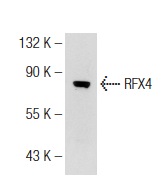
Western blot analysis of RFX4 expression in Hep G2 whole cell lysate.| Product Name | RFX4 Antibody (S-25) |
|---|---|
| Antibody Type | Primary Antibodies |
| Modification Notes | EP and EP-like sites are regulatory enhancer elements found in the promoters of several viral and mammalian genes which, in humans, include the MIF-1 binding site (MIE) of the c-Myc gene, the X box of MHC class II promoters and a binding site in the PCNA (proliferating cell nuclear antigen) promoter. The EP-like sites present in the X box of MHC class II promoters are distinctly nonpalindromic sequences that contain only a single EP-homologous half-site. The EP-like element is bound by a ubiquitous nuclear protein complex that consists of homo- and heterodimers involving the RFX1, RFX2, RFX3, RFX4 and RFX5 proteins. The RFX proteins represent an essential class II transcription factor family that share several conserved regions, including a centrally located DNA-binding domain (DBD) and a C-terminal D region that facilitates dimerization. RFX4 is a 735 amino acid nuclear protein that, via interactions with other RFX proteins, can bind DNA and is thought to activate the transcription of target genes. Four isoforms, each of which exhibit different tissue specificity, exist due to alternative splicing events. |
| Clonality | Polyclonal |
|---|---|
| Isotype | IgG |
| Host Species | Rabbit |
| Tested Applications | WBIPELISA |
| recommended for detection of RFX4 of mouse, rat, human, canine and zebra fish origin by WB, IP and ELISA | |
| Species Reactivity | HumanMouseRat |
| Concentration | 1mg/ml |
| Purification | Affinity purified |
| Alternative Names | raised against RFX4 of human origin |
|---|---|
| Tissue Specificity | raised against RFX4 of human origin |
| Entrez Gene | 5992 |
|---|
Application
Western blot analysis of RFX4 expression in Hep G2 whole cell lysate.| Application Notes | recommended for detection of RFX4 of mouse, rat, human, canine and zebra fish origin by WB, IP and ELISA |
|---|
| Form | Liquid |
|---|---|
| Storage Instructions | For short-term storage, store at 4° C. For long-term storage, aliquot and store at -20ºC or below. Avoid multiple freeze-thaw cycles. |
| Storage Buffer | phosphate buffered saline , pH 7.4, 150mM NaCl, 0.02% sodium azide and 50% glycerol. |


