Application
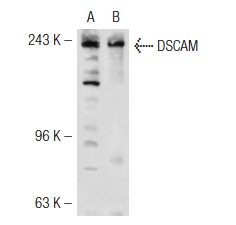
Western blot analysis of DSCAM expression in T98G whole cell lysate (A) and mouse cerebellum tissue extract (B).| Product Name | DSCAM Antibody (N-16) |
|---|---|
| Antibody Type | Primary Antibodies |
| Modification Notes | DSCAM (Down syndrome cell adhesion molecule) is a cell adhesion molecule belonging to the immunoglobulin superfamily. It is predominantly expressed in brain and contains six Fibronectin type-III domains and ten Ig-like C2-type domains. In mice, DSCAM is responsible for regulating isoneuronal self-avoidance, the tendency for sister arbors to avoid crossing each other and to spread out proportionately over an area. Isoneuronal self-avoidance is important for proper terminal branching (arborization). In some cell types, DSCAM also mediates heteroneuronal self-avoidance, which is important for the regular spacing of cell bodies and the prevention of hyperfasciculation. In humans, two DSCAM isoforms exist due to alternative splicing. The long isoform (also known as CHD2-42) is a single pass type I membrane protein, while the short isoform (CHD2-52), which lacks the C-terminal transmembrane containing region (amino acids 1572-2012), is secreted. |
| Clonality | Polyclonal |
|---|---|
| Isotype | IgG |
| Host Species | Rabbit |
| Tested Applications | WBIPIFELISA |
| recommended for detection of DSCAM of mouse, rat and human origin by WB, IP, IF and ELISA also reactive with additional species, including equine, canine, bovine and avian | |
| Species Reactivity | HumanMouseRat |
| Concentration | 1mg/ml |
| Purification | Affinity purified |
| Alternative Names | epitope mapping within an N-terminal extracellular domain of DSCAM of human origin |
|---|---|
| Tissue Specificity | epitope mapping within an N-terminal extracellular domain of DSCAM of human origin |
| Entrez Gene | 1826 |
|---|
Application
Western blot analysis of DSCAM expression in T98G whole cell lysate (A) and mouse cerebellum tissue extract (B).| Application Notes | recommended for detection of DSCAM of mouse, rat and human origin by WB, IP, IF and ELISA also reactive with additional species, including equine, canine, bovine and avian |
|---|
| Form | Liquid |
|---|---|
| Storage Instructions | For short-term storage, store at 4° C. For long-term storage, aliquot and store at -20ºC or below. Avoid multiple freeze-thaw cycles. |
| Storage Buffer | phosphate buffered saline , pH 7.4, 150mM NaCl, 0.02% sodium azide and 50% glycerol. |


