Application
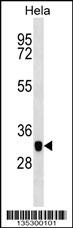
Western blot analysis of human recombinant DinB fusion protein.| Product Name | DinB Antibody (H-180) |
|---|---|
| Antibody Type | Primary Antibodies |
| Modification Notes | Problems in DNA replication may lead to breaks in the replication fork, and recombinational reactions occur to restore the integrity of the fork via strand-invasion of the broken chromosome with its homologous strand. If this happens within repeated DNA sequences, genetic rearrangements may be produced. The bacterial UmuC/DinB family consists of bypass polymerases that are responsible for translesion DNA synthesis. DinB, also referred to as DNA polyermase IV or DNA polymerase k, is an SOS-inducible, error-prone DNA polymerase that plays a role in DNA damage-induced mutagenesis by preferentially making frameshift mutations. DinB is uniquely and highly expressed in the adrenal cortex and testis, as well as in a variety of other tissues. p53 regulates DinB and exposure to various DNA-damaging agents causes an upregulation of DinB. |
| Clonality | Polyclonal |
|---|---|
| Isotype | IgG |
| Host Species | Rabbit |
| Tested Applications | WBIPIFELISAGSChIP |
| recommended for detection of all DinB isoforms of mouse, rat and human origin by WB, IP, IF and ELISA also reactive with additional species, including equine, canine, bovine and porcine | |
| Species Reactivity | HumanMouseRat |
| Concentration | 1mg/ml |
| Purification | Affinity purified |
| Alternative Names | epitope corresponding to amino acids 131-310 mapping near the N-terminus of DinB of human origin |
|---|---|
| Tissue Specificity | epitope corresponding to amino acids 131-310 mapping near the N-terminus of DinB of human origin |
| Entrez Gene | 51426 |
|---|
Application
Western blot analysis of human recombinant DinB fusion protein.| Application Notes | recommended for detection of all DinB isoforms of mouse, rat and human origin by WB, IP, IF and ELISA also reactive with additional species, including equine, canine, bovine and porcine |
|---|
| Form | Liquid |
|---|---|
| Storage Instructions | For short-term storage, store at 4° C. For long-term storage, aliquot and store at -20ºC or below. Avoid multiple freeze-thaw cycles. |
| Storage Buffer | phosphate buffered saline , pH 7.4, 150mM NaCl, 0.02% sodium azide and 50% glycerol. |


