Application
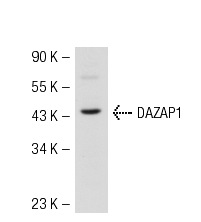
Western blot analysis of DAZAP1 expression in Hep G2 whole cell lysate.Application
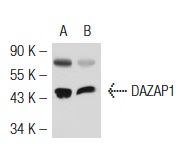
Western blot analysis of DAZAP1 expression in mouse testis (A) and rat testis (B) tissue extracts.| Product Name | DAZAP1 Antibody (H-87) |
|---|---|
| Antibody Type | Primary Antibodies |
| Modification Notes | DAZAP1 (deleted in azoospermia-associated protein 1) is a 407 amino acid RNA-binding protein that interacts with DAZ (deleted in azoospermia), a gene with multiple protein products that are deleted in infertile men. Localized to the nucleus of round spermatids and to the cytoplasm of elongated spermatids, DAZAP1 contains two RNP motifs and is thought to be essential for normal spermatogenesis. Binding of DAZAP1 to DAZ mRNA induces translation of DAZ proteins that are required for germ cell development. When DAZAP1 is phosphorylated, it dissociates from DAZ mRNA and prevents proper protein translation, thereby regulating the expression of DAZ proteins. Additionally, DAZAP1 can fuse to the DNA-binding protein MEF-2D; a fusion that disrupts proper signaling pathways and may, therefore, be involved in leukemogenesis. DAZAP1 is expressed predominately in the testis, with weak expression observed in the thymus, heart, liver, brain and pancreas. Two isoforms of DAZAP1 exist due to alternative splicing events. |
| Clonality | Polyclonal |
|---|---|
| Isotype | IgG |
| Host Species | Rabbit |
| Tested Applications | WBIPIFELISA |
| recommended for detection of DAZAP1 of mouse, rat and human origin by WB, IP, IF and ELISA also reactive with additional species, including equine, canine, bovine and porcine | |
| Species Reactivity | HumanMouseRat |
| Concentration | 1mg/ml |
| Purification | Affinity purified |
| Alternative Names | epitope corresponding to amino acids 161-247 mapping within an internal region of DAZAP1 of human origin |
|---|---|
| Tissue Specificity | epitope corresponding to amino acids 161-247 mapping within an internal region of DAZAP1 of human origin |
| Entrez Gene | 26528 |
|---|
Application
Western blot analysis of DAZAP1 expression in Hep G2 whole cell lysate.
Application
Western blot analysis of DAZAP1 expression in mouse testis (A) and rat testis (B) tissue extracts.| Application Notes | recommended for detection of DAZAP1 of mouse, rat and human origin by WB, IP, IF and ELISA also reactive with additional species, including equine, canine, bovine and porcine |
|---|
| Form | Liquid |
|---|---|
| Storage Instructions | For short-term storage, store at 4° C. For long-term storage, aliquot and store at -20ºC or below. Avoid multiple freeze-thaw cycles. |
| Storage Buffer | phosphate buffered saline , pH 7.4, 150mM NaCl, 0.02% sodium azide and 50% glycerol. |


