Application
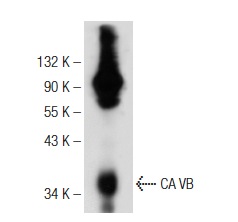
Western blot analysis of CA VB expression in rat liver tissue extract.| Product Name | CA VB Antibody (H-50) |
|---|---|
| Antibody Type | Primary Antibodies |
| Modification Notes | Carbonic anhydrases (CAs) are members of a large family of zinc metalloenzymes responsible for catalyzing the reversible hydration of carbon dioxide. CAs show extensive diversity in their distribution and subcellular localization. They are involved in a variety of biological processes, including calcification, bone resorption, respiration, acid-base balance and the formation of aqueous humor, saliva, gastric juice and cerebrospinal fluid. CA VB, also known as carbonate dehydratase VB, is one of two isoforms of CA V. It localizes to the mitochondria and is involved in metabolic processes. CA VB is predominantly expressed in heart, pancreas, lung, placenta, kidney and skeletal muscle. It exhibits highest homology with family member CA VA (the second isoform of CA V); however, unlike CA VA, it is not expressed in the liver, suggesting that it plays a significantly different physiological role. |
| Clonality | Polyclonal |
|---|---|
| Isotype | IgG |
| Host Species | Rabbit |
| Tested Applications | WBIPIFELISA |
| recommended for detection of CA VB of human and, to a lesser extent, mouse and rat origin by WB, IP, IF and ELISA also reactive with additional species, including canine | |
| Species Reactivity | HumanMouseRat |
| Concentration | 1mg/ml |
| Purification | Affinity purified |
| Alternative Names | epitope corresponding to amino acids 1-50 mapping at the N-terminus of CA VB of human origin |
|---|---|
| Tissue Specificity | epitope corresponding to amino acids 1-50 mapping at the N-terminus of CA VB of human origin |
| Entrez Gene | 11238 |
|---|
Application
Western blot analysis of CA VB expression in rat liver tissue extract.| Application Notes | recommended for detection of CA VB of human and, to a lesser extent, mouse and rat origin by WB, IP, IF and ELISA also reactive with additional species, including canine |
|---|
| Form | Liquid |
|---|---|
| Storage Instructions | For short-term storage, store at 4° C. For long-term storage, aliquot and store at -20ºC or below. Avoid multiple freeze-thaw cycles. |
| Storage Buffer | phosphate buffered saline , pH 7.4, 150mM NaCl, 0.02% sodium azide and 50% glycerol. |


