Application
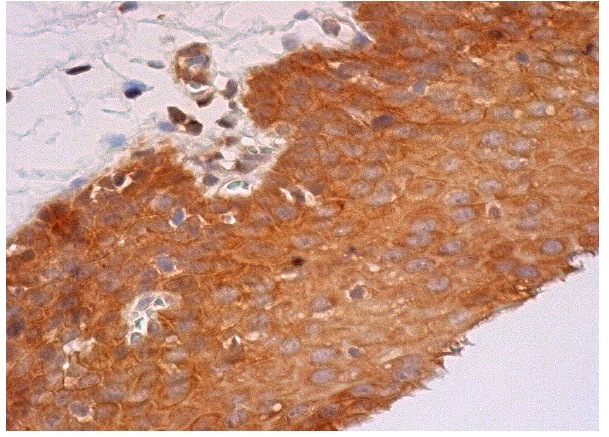
Immunoperoxidase staining of formalin fixed, paraffin-embedded human tonsil tissue showing cytoplasmic staining of squamous epithelial cells.Application
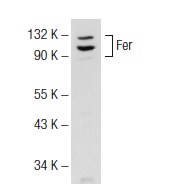
Western blot analysis of Fer expression in Jurkat whole cell lysate.| Product Name | Fer Antibody (H-180) |
|---|---|
| Antibody Type | Primary Antibodies |
| Modification Notes | Fer (p94) is a non-receptor protein-tyrosine kinase (nRTK) of the Fes/Fps family, which shares a functional (SH2) domain and is involved in signaling pathways through receptor tyrosine kinases (RTK) and cytokine receptors (1,2). The Fes/Fps family is distinct from c-Src, c-Abl and related nRTKs and was originally distinguished as a homolog to retroviral oncoproteins (3). In vivo, Fer kinase assembles into homotrimers via conserved coiled-coil domains (2). The N-terminal coiled-coil domains of Fer can autophosphorylate in trans, thereby regulating their cellular function through differential phosphorylation states (2,4). Growth factor exposure can induce tyrosine phosphorylation of Fer and recruitment of Fer to RTK complexes containing p85 (4). Fer is implicated in insulin signaling, cell-cell signaling, human prostatic proliferative diseases, and is involved in the regulation of G1 progression (4-6). |
| Clonality | Polyclonal |
|---|---|
| Isotype | IgG |
| Host Species | Rabbit |
| Tested Applications | WBIPIFIHCELISA |
| recommended for detection of Fer of mouse, rat and human origin by WB, IP, IF, IHC(P) and ELISA also reactive with additional species, including equine, canine, bovine, porcine and avian | |
| Species Reactivity | HumanMouseRat |
| Concentration | 1mg/ml |
| Purification | Affinity purified |
| Alternative Names | epitope corresponding to amino acids 101-280 mapping near the N-terminus of Fer of human origin |
|---|---|
| Tissue Specificity | epitope corresponding to amino acids 101-280 mapping near the N-terminus of Fer of human origin |
| Entrez Gene | 2241 |
|---|
Application
Immunoperoxidase staining of formalin fixed, paraffin-embedded human tonsil tissue showing cytoplasmic staining of squamous epithelial cells.
Application
Western blot analysis of Fer expression in Jurkat whole cell lysate.| Application Notes | recommended for detection of Fer of mouse, rat and human origin by WB, IP, IF, IHC(P) and ELISA also reactive with additional species, including equine, canine, bovine, porcine and avian |
|---|
| Form | Liquid |
|---|---|
| Storage Instructions | For short-term storage, store at 4° C. For long-term storage, aliquot and store at -20ºC or below. Avoid multiple freeze-thaw cycles. |
| Storage Buffer | phosphate buffered saline , pH 7.4, 150mM NaCl, 0.02% sodium azide and 50% glycerol. |


