Application
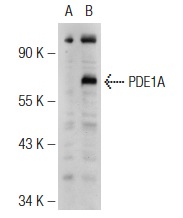
Western blot analysis of PDE1A expression in non-transfected: (A) and human PDE1A transfected: (B) 293 whole cell lysates.Application
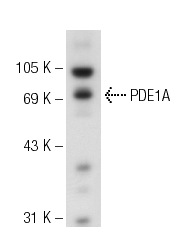
Western blot analysis of PDE1A expression in NIH/3T3 whole cell lysate.| Product Name | PDE1A Antibody (H-105) |
|---|---|
| Antibody Type | Primary Antibodies |
| Modification Notes | Phosphodiesterases (PDE, also designated cyclic nucleotide phosphodiesterase) are important for the downregulation of the intracellular level of the second messenger cyclic adenosine monophosphate (cAMP) by hydrolyzing cAMP to 5'AMP. The PDE1 family are calmodulin-dependent (CaM-PDE) proteins that undergo stimulation through a calcium-calmodulin complex. The activation of PDE1A requires a sustained influx of Ca2+. Excluding its two short unique regions, human PDE1A has a predicted amino acid sequence exhibiting 94% homology to PDE of cow origin. PDE1A is most highly expressed in the brain, heart, kidney and skeletal muscle. |
| Clonality | Polyclonal |
|---|---|
| Isotype | IgG |
| Host Species | Rabbit |
| Tested Applications | WBIPIFELISA |
| recommended for detection of PDE1A of mouse, rat and human origin by WB, IP, IF and ELISA | |
| Species Reactivity | HumanMouseRat |
| Concentration | 1mg/ml |
| Purification | Affinity purified |
| Alternative Names | epitope corresponding to amino acids 431-535 mapping at the C-terminus of PDE1A of human origin |
|---|---|
| Tissue Specificity | epitope corresponding to amino acids 431-535 mapping at the C-terminus of PDE1A of human origin |
| Entrez Gene | 5136 |
|---|
Application
Western blot analysis of PDE1A expression in non-transfected: (A) and human PDE1A transfected: (B) 293 whole cell lysates.
Application
Western blot analysis of PDE1A expression in NIH/3T3 whole cell lysate.| Application Notes | recommended for detection of PDE1A of mouse, rat and human origin by WB, IP, IF and ELISA |
|---|
| Form | Liquid |
|---|---|
| Storage Instructions | For short-term storage, store at 4° C. For long-term storage, aliquot and store at -20ºC or below. Avoid multiple freeze-thaw cycles. |
| Storage Buffer | phosphate buffered saline , pH 7.4, 150mM NaCl, 0.02% sodium azide and 50% glycerol. |


