Application
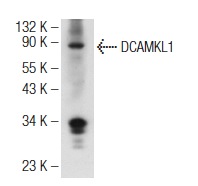
Western blot analysis of DCAMKL1 expression in NIH/3T3 whole cell lysate.| Product Name | DCAMKL1 Antibody (H-55) |
|---|---|
| Antibody Type | Primary Antibodies |
| Modification Notes | Lissencephaly (smooth brain) is an abnormality of brain development characterized by incomplete neuronal migration and a smooth cerebral surface, manifesting as severe mental retardation. Genetic analysis has identified two proteins that are mutated in some cases of lissencephaly, designated lissencephaly-1 protein (LIS1) and doublecortin. LIS1 displays sequence homology to ß-subunits of heterotrimeric G proteins, and doublecortin contains a consensus Abl phosphorylation site. In addition, the DCAMKL1 (doublecortin-like and CAM kinase-like 1) protein shows homology to doublecortin. All three proteins are highly expressed in developing brain and may function together to regulate microtubules involved in neuronal migration. The DCAMKL1 protein encodes a functional kinase that is capable of phosphorylating myelin basic protein and itself, but its kinase activity does not appear to affect its microtubule polymerization activity. |
| Clonality | Polyclonal |
|---|---|
| Isotype | IgG |
| Host Species | Rabbit |
| Tested Applications | WBIPIFELISA |
| recommended for detection of DCAMKL1 of mouse, rat and human origin by WB, IP, IF and ELISA also reactive with additional species, including equine, canine and avian | |
| Species Reactivity | HumanMouseRat |
| Concentration | 1mg/ml |
| Purification | Affinity purified |
| Alternative Names | epitope corresponding to amino acids 626-680 mapping near the C-terminus of DCAMKL1 of human origin |
|---|---|
| Tissue Specificity | epitope corresponding to amino acids 626-680 mapping near the C-terminus of DCAMKL1 of human origin |
| Entrez Gene | 9201 |
|---|
Application
Western blot analysis of DCAMKL1 expression in NIH/3T3 whole cell lysate.| Application Notes | recommended for detection of DCAMKL1 of mouse, rat and human origin by WB, IP, IF and ELISA also reactive with additional species, including equine, canine and avian |
|---|
| Form | Liquid |
|---|---|
| Storage Instructions | For short-term storage, store at 4° C. For long-term storage, aliquot and store at -20ºC or below. Avoid multiple freeze-thaw cycles. |
| Storage Buffer | phosphate buffered saline , pH 7.4, 150mM NaCl, 0.02% sodium azide and 50% glycerol. |


