Application
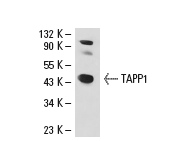
Western blot analysis of TAPP1 expression in mouse skeletal muscle tissue extract.| Product Name | TAPP1 Antibody (H-80) |
|---|---|
| Antibody Type | Primary Antibodies |
| Modification Notes | Tandem PH (pleckstrin homology) domain-containing protein 1 (TAPP1) is a widely expressed cytoplasmic adaptor protein related to Bam32. Highest expression levels of TAPP1 are found in skeletal muscle, spleen, lung, thymus and placenta. Upon growth factor stimulation and activation of phosphoinositol 3-kinase, TAPP1 is recruited to the plasma membrane and accumulates in the F-actin-rich membrane ruffles. This recruitment occurs through the specific interaction of the TAPP1 C-terminal PH domain with phosphotidylinositol 3,4-bisphosphate. Syntrophins are responsible for regulating the localization of TAPP1, and together, this may regulate actin-mediated membrane ruffling and cytoskeletal reorganization. The overexpression of TAPP1, in the absence of syntrophin overexpression, blocks the formation of circular ruffles. TAPP1 may also be involved in the activation of B and T cells. |
| Clonality | Polyclonal |
|---|---|
| Isotype | IgG |
| Host Species | Rabbit |
| Tested Applications | WBIPIFELISA |
| recommended for detection of TAPP1 of mouse, rat and human origin by WB, IP, IF and ELISA also reactive with additional species, including equine, canine, bovine and porcine | |
| Species Reactivity | HumanMouseRat |
| Concentration | 1mg/ml |
| Purification | Affinity purified |
| Alternative Names | epitope corresponding to amino acids 116-195 mapping within an internal region of TAPP1 of human origin |
|---|---|
| Tissue Specificity | epitope corresponding to amino acids 116-195 mapping within an internal region of TAPP1 of human origin |
| Entrez Gene | 59338 |
|---|
Application
Western blot analysis of TAPP1 expression in mouse skeletal muscle tissue extract.| Application Notes | recommended for detection of TAPP1 of mouse, rat and human origin by WB, IP, IF and ELISA also reactive with additional species, including equine, canine, bovine and porcine |
|---|
| Form | Liquid |
|---|---|
| Storage Instructions | For short-term storage, store at 4° C. For long-term storage, aliquot and store at -20ºC or below. Avoid multiple freeze-thaw cycles. |
| Storage Buffer | phosphate buffered saline , pH 7.4, 150mM NaCl, 0.02% sodium azide and 50% glycerol. |


