Application
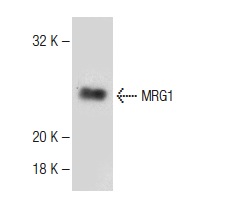
Western blot analysis of MRG1 expression in C32 nuclear extract.Application
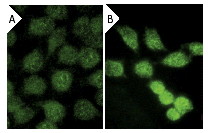
Immunofluorescense staining of methanol-fixed HeLa cells showing weak nuclear (A) and strong nuclear localization after IL-6 induction (B).| Product Name | MRG1 Antibody (H-220) |
|---|---|
| Antibody Type | Primary Antibodies |
| Modification Notes | MRG1 (MSG1-related gene 1) is a primary response gene that shares substantial sequence similarity to the carboxy-terminal region of MSG1 (melanocyte-specific gene-1). Both MRG1 and MSG1 contain two conserved domains designated CR1 and CR2, the latter of which is required for transcriptional activation, and they appear to represent a unique family of transcription factors. MRG1 expression is induced by cytokines, including IL-1a, IL-9, and GM-CSF, as well as by serum growth factors, and it is regulated by the JAK/ Stat pathway. Overexpression of MRG1 induces anchorage-independent growth in soft agar, loss of cell contact inhibition and tumor formation in nude mice, suggesting that MRG1 is a transforming gene with oncogenic properties. A splice variant of MRG1, designated p35srj, is ubiquitously expressed and interacts with the p300-CH1 domain of p300/CBP, where it inhibits the interaction of p300/CBP with hypoxia-inducible factor-1a (HIF-1a) to prevent HIF-1 transactivation. |
| Clonality | Polyclonal |
|---|---|
| Isotype | IgG |
| Host Species | Rabbit |
| Tested Applications | WBIPIFELISAGSChIP |
| recommended for detection of MRG1 of mouse, rat and human origin by WB, IP, IF and ELISA also reactive with additional species, including equine, canine, bovine and porcine | |
| Species Reactivity | HumanMouseRat |
| Concentration | 1mg/ml |
| Purification | Affinity purified |
| Alternative Names | epitope corresponding to amino acids 1-130 of MRG1 of human origin |
|---|---|
| Tissue Specificity | epitope corresponding to amino acids 1-130 of MRG1 of human origin |
| Entrez Gene | 10370 |
|---|
Application
Western blot analysis of MRG1 expression in C32 nuclear extract.
Application
Immunofluorescense staining of methanol-fixed HeLa cells showing weak nuclear (A) and strong nuclear localization after IL-6 induction (B).| Application Notes | recommended for detection of MRG1 of mouse, rat and human origin by WB, IP, IF and ELISA also reactive with additional species, including equine, canine, bovine and porcine |
|---|
| Form | Liquid |
|---|---|
| Storage Instructions | For short-term storage, store at 4° C. For long-term storage, aliquot and store at -20ºC or below. Avoid multiple freeze-thaw cycles. |
| Storage Buffer | phosphate buffered saline , pH 7.4, 150mM NaCl, 0.02% sodium azide and 50% glycerol. |


