Application
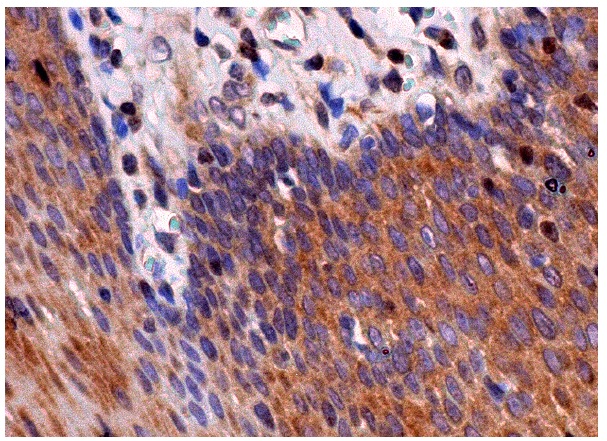
Immunoperoxidase staining of formalin fixed, paraffin-embedded human esophagus tissue showing cytoplasmic staining of squamous epithelial cells.| Product Name | AGRP Antibody (H-53) |
|---|---|
| Antibody Type | Primary Antibodies |
| Modification Notes | ASP (agouti signaling protein or agouti switch protein) is a paracrine signaling molecule that causes hair follicle melanocytes to synthesize pheomelanin, a yellow pigment, instead of the black or brown pigment eumelanin (1). Consequently, agouti mice produce hairs with a subapical yellow band on an otherwise black or brown background when expressed during the midportion of hair growth (1). ASP is a 132-amino acid protein with a consensus signal peptide, indicating that the protein is probably secreted and is normally expressed in neonatal skin (1). The gene which encodes for ASP maps to human chromosome 20q11.2 (2). AGRP (agouti-related protein) is a potent, selective antagonist of MC3R and MC4R (3). AGRP normally regulates body weight via central melanocortin receptors, analogous to the relation between agouti and MC1R for regulation of pigmentation (3). AGRP is expressed primarily in the adrenal gland, subthalamic nucleus and hypothalamus, with a lower level of expression occurring in testis, lung and kidney (4,5). The gene which encodes for AGRP maps to human chromosome 16q22 (4). |
| Clonality | Polyclonal |
|---|---|
| Isotype | IgG |
| Host Species | Rabbit |
| Tested Applications | WBIPIFIHCELISA |
| recommended for detection of AGRP of mouse, rat and human origin by WB, IP, IF, IHC(P) and ELISA | |
| Species Reactivity | HumanMouseRat |
| Concentration | 1mg/ml |
| Purification | Affinity purified |
| Alternative Names | epitope corresponding to amino acids 51-103 mapping within an internal region of AGRP of human origin |
|---|---|
| Tissue Specificity | epitope corresponding to amino acids 51-103 mapping within an internal region of AGRP of human origin |
| Entrez Gene | 181 |
|---|
Application
Immunoperoxidase staining of formalin fixed, paraffin-embedded human esophagus tissue showing cytoplasmic staining of squamous epithelial cells.| Application Notes | recommended for detection of AGRP of mouse, rat and human origin by WB, IP, IF, IHC(P) and ELISA |
|---|
| Form | Liquid |
|---|---|
| Storage Instructions | For short-term storage, store at 4° C. For long-term storage, aliquot and store at -20ºC or below. Avoid multiple freeze-thaw cycles. |
| Storage Buffer | phosphate buffered saline , pH 7.4, 150mM NaCl, 0.02% sodium azide and 50% glycerol. |


