Application
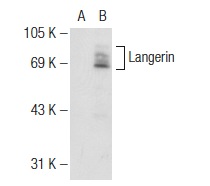
Western blot analysis of Langerin expression in non-transfected: (A) and human Langerin transfected: (B) 293 whole cell lysates.| Product Name | Langerin Antibody (H-200) |
|---|---|
| Antibody Type | Primary Antibodies |
| Modification Notes | Langerhans cells (LCs) are a subset of immature dendritic cells (DCs) that specifically localize in the epidermis and other mucosal epithelia (1,2). Epidermal LCs possess strong immunostimulatory capacity and play a central role in the initiation and regulation of immune responses (2–4). Langerin (CD207) is a Ca(++)-dependent, C-type lectin domain-containing, type II transmembrane protein that induces epidermal LCs to differentiate into Birbeck granules (BG) (3,4). BGs are organelles with superimposing and zippering membranes that influence proper class I type antigen presentation to the circulating T-cells. (5–7). Human spleen, lymph node, thymus, liver, lung and heart express langerin protein (8). The human langerin gene maps to chromosome 2p13 and encodes a 328 amino acid protein (1,7,8). |
| Clonality | Polyclonal |
|---|---|
| Isotype | IgG |
| Host Species | Rabbit |
| Tested Applications | WBIPIFELISA |
| recommended for detection of Langerin of human origin by WB, IP, IF and ELISA | |
| Species Reactivity | HumanMouseRat |
| Concentration | 1mg/ml |
| Purification | Affinity purified |
| Alternative Names | epitope corresponding to amino acids 1-200 mapping at the N-terminus of Langerin of human origin |
|---|---|
| Tissue Specificity | epitope corresponding to amino acids 1-200 mapping at the N-terminus of Langerin of human origin |
| Entrez Gene | 50489 |
|---|
Application
Western blot analysis of Langerin expression in non-transfected: (A) and human Langerin transfected: (B) 293 whole cell lysates.| Application Notes | recommended for detection of Langerin of human origin by WB, IP, IF and ELISA |
|---|
| Form | Liquid |
|---|---|
| Storage Instructions | For short-term storage, store at 4° C. For long-term storage, aliquot and store at -20ºC or below. Avoid multiple freeze-thaw cycles. |
| Storage Buffer | phosphate buffered saline , pH 7.4, 150mM NaCl, 0.02% sodium azide and 50% glycerol. |


