Application
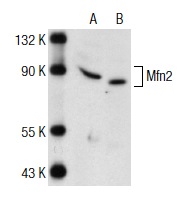
Western blot analysis of Mfn2 expression in A10 (A) and Hep G2 (B) whole cell lysates.| Product Name | Mfn2 Antibody (H-68) |
|---|---|
| Antibody Type | Primary Antibodies |
| Modification Notes | Mitofusin 1 (Mfn1) and mitofusin 2 (Mfn2) are homologs for the Drosophila protein fuzzy onion (Fzo). They are mitochondrial membrane proteins and are mediators of mitochondrial fusion. A GTPase domain is required for Mfn protein function but the molecular mechanisms of the GTPase-dependent reaction as well as the functional division of the two Mfn proteins are unknown. They are essential for embryonic development and may play a role in the pathobiology of obesity. Although the Mfn1 and Mfn2 genes are broadly expressed, they show different levels of expression in different tissues. Two Mfn1 transcripts are elevated in heart, while Mfn2 mRNA is abundantly expressed in heart and muscle tissue but present only at low levels in many other tissues. Mfn1 localizes to mitochondria and participates in at least two different high molecular weight protein complexes in a GTP-dependent manner. Purified recombinant Mfn1 exhibited approximately eightfold higher GTPase activity than Mfn2. |
| Clonality | Polyclonal |
|---|---|
| Isotype | IgG |
| Host Species | Rabbit |
| Tested Applications | WBIPIFELISA |
| recommended for detection of Mitofusin 2 of mouse, rat and human origin by WB, IP, IF and ELISA also reactive with additional species, including equine, canine, bovine, porcine and avian | |
| Species Reactivity | HumanMouseRat |
| Concentration | 1mg/ml |
| Purification | Affinity purified |
| Alternative Names | epitope corresponding to amino acids 461-528 mapping within a cytoplasmic domain of Mfn2 of human origin |
|---|---|
| Tissue Specificity | epitope corresponding to amino acids 461-528 mapping within a cytoplasmic domain of Mfn2 of human origin |
| Entrez Gene | 9927 |
|---|
Application
Western blot analysis of Mfn2 expression in A10 (A) and Hep G2 (B) whole cell lysates.| Application Notes | recommended for detection of Mitofusin 2 of mouse, rat and human origin by WB, IP, IF and ELISA also reactive with additional species, including equine, canine, bovine, porcine and avian |
|---|
| Form | Liquid |
|---|---|
| Storage Instructions | For short-term storage, store at 4° C. For long-term storage, aliquot and store at -20ºC or below. Avoid multiple freeze-thaw cycles. |
| Storage Buffer | phosphate buffered saline , pH 7.4, 150mM NaCl, 0.02% sodium azide and 50% glycerol. |


