Application
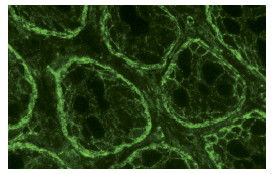
Immunofluorescence staining of normal mouse intestine frozen section showing membrane staining.| Product Name | MRCKβ Antibody (H-125) |
|---|---|
| Antibody Type | Primary Antibodies |
| Modification Notes | Protein kinases comprise a large group of encoded factors that regulate cellular processes by catalyzing the transfer of a phosphate group to a hydroxyl acceptor in serine, threonine or tyrosine residues (1,2). Myotonic dystrophy kinase-related Cdc42-binding (DMPK-like) kinases-a and b (MRCK-a, b) contain a cysteine-rich motif and a putative pleckstrin homology domain (3). MRCKs can phosphorylate nonmuscle myosin light chain and influences actin-myosin contractility (3,4). MRCK-a can phosphorylate and activate LIM kinases downstream of Cdc42, which leads to inactivation of ADF/cofilin and to Actin cytoskeletal reorganization (5). MRCK-a can also influence neurite outgrowth promoted by Cdc42 and Rac (6). |
| Clonality | Polyclonal |
|---|---|
| Isotype | IgG |
| Host Species | Rabbit |
| Tested Applications | WBIPIFELISA |
| recommended for detection of MRCK&beta of mouse, rat and human origin by WB, IP, IF and ELISA also reactive with additional species, including equine, canine and porcine | |
| Species Reactivity | HumanMouseRat |
| Concentration | 1mg/ml |
| Purification | Affinity purified |
| Alternative Names | epitope corresponding to amino acids 916-1040 mapping within an internal region of MRCK&beta of human origin |
|---|---|
| Tissue Specificity | epitope corresponding to amino acids 916-1040 mapping within an internal region of MRCKβ of human origin |
| Entrez Gene | 9578 |
|---|
Application
Immunofluorescence staining of normal mouse intestine frozen section showing membrane staining.| Application Notes | recommended for detection of MRCK&beta of mouse, rat and human origin by WB, IP, IF and ELISA also reactive with additional species, including equine, canine and porcine |
|---|
| Form | Liquid |
|---|---|
| Storage Instructions | For short-term storage, store at 4° C. For long-term storage, aliquot and store at -20ºC or below. Avoid multiple freeze-thaw cycles. |
| Storage Buffer | phosphate buffered saline , pH 7.4, 150mM NaCl, 0.02% sodium azide and 50% glycerol. |


