Application
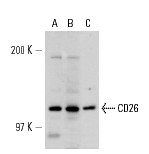
Western blot analysis of CD26 expression in CCRF-CEM (A), GA-10 (B) and AML-193 (C) whole cell lysates.| Product Name | CD26 Antibody (H-270) |
|---|---|
| Antibody Type | Primary Antibodies |
| Modification Notes | CD26 (dipeptidylpeptidase 4, adenosine deaminase complexing protein 2, ADABP, ADCP2, DPPIV, TP103) is a membrane glycoprotein and a serine exopeptidase that cleaves X-proline dipeptides from the N-terminus of polypeptides. CD26 has an essential role in immune regulation as a T cell activation molecule and a regulator of chemokine function. CD26 associates with CXCR4 and gp120 and may influence the pathophysiology of HIV infection. Adenosine deaminase (ADA) colocalizing with adenosine receptors on dendritic cells are able to interact with CD26 expressed on lymphocytes. This costimulatory signal in the immunological synapse leads to an increase in the production of the T helper 1 and proinflammatory cytokines IFN-gamma, TNF-alpha, and IL-6. CD26 plays a role in the pathogenesis and behavior of human cancers, including solid tumors and hematological malignancies. CD26-caveolin-1 interaction plays a role in the up-regulation of CD86 on TT-loaded monocytes and subsequent engagement with CD28 on T cells, leading to antigen-specific T cell activation. |
| Clonality | Polyclonal |
|---|---|
| Isotype | IgG |
| Host Species | Rabbit |
| Tested Applications | WBIPIFELISA |
| recommended for detection of CD26 of mouse, rat and human origin by WB, IP, IF and ELISA also reactive with additional species, including equine | |
| Species Reactivity | HumanMouseRat |
| Concentration | 1mg/ml |
| Purification | Affinity purified |
| Alternative Names | epitope corresponding to amino acids 261-530 mapping within an internal region of CD26 of human origin |
|---|---|
| Tissue Specificity | epitope corresponding to amino acids 261-530 mapping within an internal region of CD26 of human origin |
| Entrez Gene | 1803 |
|---|
Application
Western blot analysis of CD26 expression in CCRF-CEM (A), GA-10 (B) and AML-193 (C) whole cell lysates.| Application Notes | recommended for detection of CD26 of mouse, rat and human origin by WB, IP, IF and ELISA also reactive with additional species, including equine |
|---|
| Form | Liquid |
|---|---|
| Storage Instructions | For short-term storage, store at 4° C. For long-term storage, aliquot and store at -20ºC or below. Avoid multiple freeze-thaw cycles. |
| Storage Buffer | phosphate buffered saline , pH 7.4, 150mM NaCl, 0.02% sodium azide and 50% glycerol. |


