Application
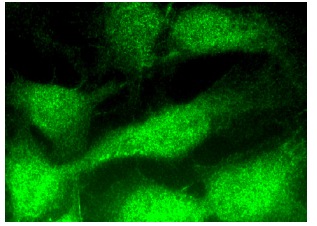
Immunofluorescence staining of formalin-fixed Hep G2 cells showing nuclear and cytoplasmic localization.Application
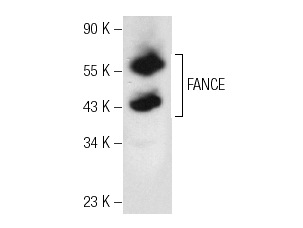
Western blot analysis of FANCE expression in Hep G2 whole cell lysate.| Product Name | FANCE Antibody (H-300) |
|---|---|
| Antibody Type | Primary Antibodies |
| Modification Notes | Fanconi anemia (FA) is an autosomal recessive disorder characterized by bone marrow failure, birth defects and chromosomal instability (1-8). At the cellular level, FA is characterized by spontaneous chromosomal breakage and a unique hypersensitivity to DNA cross-linking agents (1). At least 8 complementation groups (A-G) have been identified and 6 FA genes (for subtypes A, C, D2, E F, and G) have been cloned (2). The FA proteins lack sequence homologies or motifs that could point to a molecular function (1). Phosphorylation of FANC (Fanconi anemia complementation group) proteins is thought to be important for the function of the FA pathway (2,3). FA proteins encoded by 6 cloned FA genes (FANCA, FANCC, FANCD2, FANCE, FANCF, and FANCG) cooperate in a common pathway, culminating in the monoubiquitination of FANCD2 protein and the colocalization of FANCD2 and BRCA1 proteins in nuclear foci (4-6). The human FANCE gene maps to chromosome 6p22-p21, contains 10 exons and encodes a novel 536-amino acid protein with two potential nuclear localization signals (7,8). |
| Clonality | Polyclonal |
|---|---|
| Isotype | IgG |
| Host Species | Rabbit |
| Tested Applications | WBIPIFELISA |
| recommended for detection of FANCE of human and, to a lesser extent, mouse and rat origin by WB, IP, IF and ELISA | |
| Species Reactivity | HumanMouseRat |
| Concentration | 1mg/ml |
| Purification | Affinity purified |
| Alternative Names | epitope corresponding to amino acids 237-536 mapping at the C-terminus of FANCE of human origin |
|---|---|
| Tissue Specificity | epitope corresponding to amino acids 237-536 mapping at the C-terminus of FANCE of human origin |
| Entrez Gene | 2178 |
|---|
Application
Immunofluorescence staining of formalin-fixed Hep G2 cells showing nuclear and cytoplasmic localization.
Application
Western blot analysis of FANCE expression in Hep G2 whole cell lysate.| Application Notes | recommended for detection of FANCE of human and, to a lesser extent, mouse and rat origin by WB, IP, IF and ELISA |
|---|
| Form | Liquid |
|---|---|
| Storage Instructions | For short-term storage, store at 4° C. For long-term storage, aliquot and store at -20ºC or below. Avoid multiple freeze-thaw cycles. |
| Storage Buffer | phosphate buffered saline , pH 7.4, 150mM NaCl, 0.02% sodium azide and 50% glycerol. |


