Application
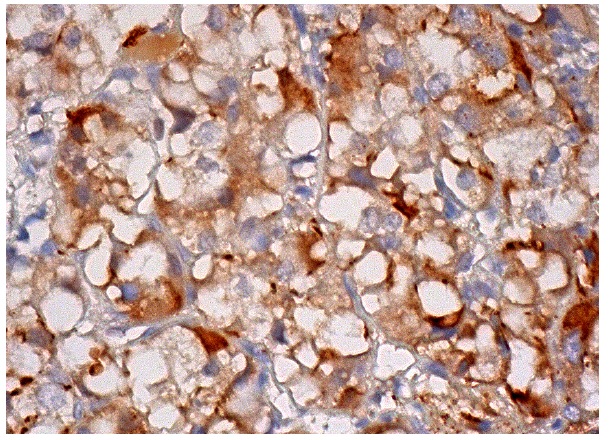
Immunoperoxidase staining of formalin fixed, paraffin-embedded human adrenal gland tissue showing cytoplasmic staining of glandular cells.| Product Name | Inhibin α Antibody (H-134) |
|---|---|
| Antibody Type | Primary Antibodies |
| Antigen Alias | epitope corresponding to amino acids 233-366 mapping at the C-terminus of Inhibin α of human origin |
| Modification Notes | Inhibin is a gonadal protein that preferentially suppresses the secretion of pituitary follicle-stimulating hormone (FSH). Inhibin comprises two subunits, Inhibin A and Inhibin B. Each subunit consists of the same α subunit, covalently linked to 1 of 2 distinct subunits, β-α or β-β. Originally isolated from ovarian follicular fluid and characterized as a disulphide-linked dimeric glycoprotein, inhibin belongs to the transforming growth factor β (TGFβ) superfamily of growth and differentiation factors. TGFβ proteins affect a range of tissues and systems beyond their role in reproduction. In addition to their role in endocrine feedback in the reproductive sytem, inhibins subserve local regulatory roles in numerous extragonadal tissues, including brain, adrenal, bone marrow, placenta and, most notably, anterior pituitary. Inhibin α-subunit gene expression is down regulated in human prostate cancer, suggesting a tumor-suppressive role. The human Inhibin α gene maps to chromosome 2q33-q36. |
| Clonality | Polyclonal |
|---|---|
| Isotype | IgG |
| Host Species | Rabbit |
| Tested Applications | WBIPIFIHCELISA |
| recommended for detection of Inhibin α of mouse, rat and human origin by WB, IP, IF, IHC(P) and ELISA also reactive with additional species, including equine and bovine: |
|
| Species Reactivity | HumanMouseRat |
| Concentration | 1mg/ml |
| Purification | Affinity purified |
| Alternative Names | epitope corresponding to amino acids 233-366 mapping at the C-terminus of Inhibin &alpha of human origin |
|---|---|
| Tissue Specificity | epitope corresponding to amino acids 233-366 mapping at the C-terminus of Inhibin α of human origin |
| Entrez Gene | 3623 |
|---|
Application
Immunoperoxidase staining of formalin fixed, paraffin-embedded human adrenal gland tissue showing cytoplasmic staining of glandular cells.| Application Notes | recommended for detection of Inhibin α of mouse, rat and human origin by WB, IP, IF, IHC(P) and ELISA also reactive with additional species, including equine and bovine: |
|---|
| Form | Liquid |
|---|---|
| Storage Instructions | For short-term storage, store at 4° C. For long-term storage, aliquot and store at -20ºC or below. Avoid multiple freeze-thaw cycles. |
| Storage Buffer | phosphate buffered saline , pH 7.4, 150mM NaCl, 0.02% sodium azide and 50% glycerol. |


