Application
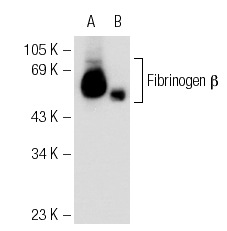
Western blot analysis of Fibrinogen β expression in c4 whole cell lysate (A) and full length human recombinant Fibrinogen β (B).| Product Name | Fibrinogen β Antibody (H-270) |
|---|---|
| Antibody Type | Primary Antibodies |
| Antigen Alias | epitope corresponding to amino acids 31-300 mapping near the N-terminus of Fibrinogen β of human origin |
| Modification Notes | The plasma glycoprotein Fibrinogen is synthesized in the liver and comprises three structurally different subunits: a, b and g. Fibrinogen is important in platelet aggregation, the final step of the coagulation cascade (i.e. the formation of Fibrin) and determination of plasma viscosity and erythrocyte aggregation. It is both constitutively expressed and inducible during an acute phase reaction. Hemostasis following tissue injury deploys essential plasma procoagulants (Prothrombin and Factors X, IX, V and VIII), which are involved in a blood coagulation cascade leading to the formation of insoluble Fibrin clots and the promotion of platelet aggregation. Following vascular injury, Fibrinogen is cleaved by Thrombin to form Fibrin, which is the most abundant component of blood clots. The cleavage products of Fibrinogen regulate cell adhesion and spreading, display vasoconstrictor and chemotactic activities, and are mitogens for several cell types. |
| Clonality | Polyclonal |
|---|---|
| Isotype | IgG |
| Host Species | Rabbit |
| Tested Applications | WBIPIFELISA |
| recommended for detection of Fibrinogen β and Fibrinopeptide B of mouse, rat and human origin by WB, IP, IF and ELISA: |
|
| Species Reactivity | HumanMouseRat |
| Concentration | 1mg/ml |
| Purification | Affinity purified |
| Alternative Names | epitope corresponding to amino acids 31-300 mapping near the N-terminus of Fibrinogen &beta of human origin |
|---|---|
| Tissue Specificity | epitope corresponding to amino acids 31-300 mapping near the N-terminus of Fibrinogen β of human origin |
| Entrez Gene | 2244 |
|---|
Application
Western blot analysis of Fibrinogen β expression in c4 whole cell lysate (A) and full length human recombinant Fibrinogen β (B).| Application Notes | recommended for detection of Fibrinogen β and Fibrinopeptide B of mouse, rat and human origin by WB, IP, IF and ELISA: |
|---|
| Form | Liquid |
|---|---|
| Storage Instructions | For short-term storage, store at 4° C. For long-term storage, aliquot and store at -20ºC or below. Avoid multiple freeze-thaw cycles. |
| Storage Buffer | phosphate buffered saline , pH 7.4, 150mM NaCl, 0.02% sodium azide and 50% glycerol. |


