Application
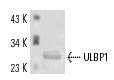
Western blot analysis of ULBP1 expression in Hep G2 whole cell lysate.| Product Name | ULBP1 Antibody (H-46) |
|---|---|
| Antibody Type | Primary Antibodies |
| Modification Notes | The immune system contains genetically encoded subsystems, which monitor the extracellular environment in order to eliminate pathogens and resolve abnormal or transformed tissues. Cytomegalovirus UL16 binding proteins, known as ULBPs, are GPI-linked glycoproteins that belong to the extended MHC class I family and are distantly related to MHC class I polypeptide-related sequence B, known as MICB (1–3). ULBP and MICB proteins are ligands for the activating receptor NKG2D/DAP10, which causes lymphocyte activation resulting in the secretion of cytokines, such as interferon-gamma, and tumor cell lysis (2–4). The interaction of ULBP or MICB with NKG2D/DAP10 can be blocked by the soluble form of UL16 (3,4). ULBPs stimulate cytokine and chemokine production from NK cells, CD8 alpha/beta T cells, and gamma/delta T cells (4,5). Soluble forms of ULBPs induce protein tyrosine phosphorylation and activation of the Janus kinase 2, STAT5, extracellular signal-regulated kinase, mitogen-activated protein kinase and phosphatidylinositol 3-kinase (PI 3-kinase)/Akt signal transduction pathways (2). |
| Clonality | Polyclonal |
|---|---|
| Isotype | IgG |
| Host Species | Rabbit |
| Tested Applications | WBIPIFELISA |
| recommended for detection of ULBP1 of human origin by WB, IP, IF and ELISA | |
| Species Reactivity | HumanMouseRat |
| Concentration | 1mg/ml |
| Purification | Affinity purified |
| Alternative Names | epitope corresponding to amino acids 171-216 mapping near the C-terminus of ULBP1 of human origin |
|---|---|
| Tissue Specificity | epitope corresponding to amino acids 171-216 mapping near the C-terminus of ULBP1 of human origin |
| Entrez Gene | 80329 |
|---|
Application
Western blot analysis of ULBP1 expression in Hep G2 whole cell lysate.| Application Notes | recommended for detection of ULBP1 of human origin by WB, IP, IF and ELISA |
|---|
| Form | Liquid |
|---|---|
| Storage Instructions | For short-term storage, store at 4° C. For long-term storage, aliquot and store at -20ºC or below. Avoid multiple freeze-thaw cycles. |
| Storage Buffer | phosphate buffered saline , pH 7.4, 150mM NaCl, 0.02% sodium azide and 50% glycerol. |


