Application
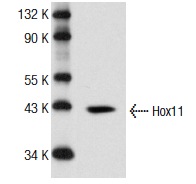
Western blot analysis of Hox11 expression in Sol8 nuclear extract.Application
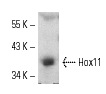
Western blot analysis of Hox11 expression in ALL-SIL whole cell lysate.| Product Name | Hox11 Antibody (C-18) |
|---|---|
| Antibody Type | Primary Antibodies |
| Antigen Alias | epitope mapping at the C-terminus of Hox11 of human origin |
| Modification Notes | The Hox proteins play a role in patterns of embryonic development and cellular differentiation by regulating downstream target genes. The Hox11 gene, termed an orphan homeobox gene, as it is located outside of the four mammalian Hox clusters, is a DNA-binding nuclear transcription factor. The human Hox11 gene maps to chromosome 10q24 and has been implicated in the chromosomal translocation t(7;10)(q24;q11) that occurs in T-cell acute lymphoblastic leukemia (T-ALL). The t(7:10) translocation occurs between the Hox11 gene and the T-cell receptor (TCR) delta-chain gene and is a result of aberrant physiological recombinational events at the early stages of T-cell development. The Hox11 gene is normally expressed in the splanchnic anlage arising from the splanchnic mesoderm. Homozygous Hox11-deficient mice have no spleen, while all other splanchnic derivatives develop normally. Spleen development starts and proceeds normally in Hox11-deficient mice to a specific stage of embryogenesis, when the spleen anlage becomes fully absorbed. |
| Clonality | Polyclonal |
|---|---|
| Isotype | IgG |
| Host Species | Rabbit |
| Tested Applications | WBIPIFELISAGSChIP |
| recommended for detection of Hox11 of mouse, rat and human origin by WB, IP, IF and ELISA also reactive with additional species, including equine, canine, bovine and avian: |
|
| Species Reactivity | HumanMouseRat |
| Concentration | 1mg/ml |
| Purification | Affinity purified |
| Alternative Names | epitope mapping at the C-terminus of Hox11 of human origin |
|---|---|
| Tissue Specificity | epitope mapping at the C-terminus of Hox11 of human origin |
| Entrez Gene | 3195 |
|---|
Application
Western blot analysis of Hox11 expression in Sol8 nuclear extract.
Application
Western blot analysis of Hox11 expression in ALL-SIL whole cell lysate.| Application Notes | recommended for detection of Hox11 of mouse, rat and human origin by WB, IP, IF and ELISA also reactive with additional species, including equine, canine, bovine and avian: |
|---|
| Form | Liquid |
|---|---|
| Storage Instructions | For short-term storage, store at 4° C. For long-term storage, aliquot and store at -20ºC or below. Avoid multiple freeze-thaw cycles. |
| Storage Buffer | phosphate buffered saline , pH 7.4, 150mM NaCl, 0.02% sodium azide and 50% glycerol. |


