Application
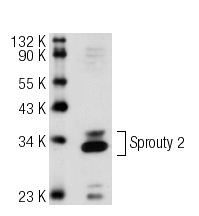
Western blot analysis of Sprouty 2 expression in C32 whole cell lysate.| Product Name | Sprouty 2 Antibody (H-120) |
|---|---|
| Antibody Type | Primary Antibodies |
| Antigen Alias | epitope corresponding to amino acids 61-180 mapping within an internal region of Sprouty 2 of human origin |
| Modification Notes | Members of the Sprouty family (Sprouty 1-4) are inducible negative regulators of growth factors that act through tyrosine kinase receptors. Mammalian Sprouty homologs share a well-conserved cysteine-rich C-terminal domain with their Drosophila counterparts. Both Sprouty 1 and 2 are anchored to membranes by palmitoylation, associate with caveolin-1 in perinuclear and vesicular structures and are phosphorylated on Serine residues. Upon stimulation, a subset is recruited to the leading edge of the plasma membrane. Sprouty 2 can associate with c-Cbl, a down regulator of RTK signaling, and inhibits the activities of several growth factors. Sprouty 2 also functions as a negative regulator of embryonic lung morphogenesis and growth. The well-conserved C-terminus of Sprouty contains two domains which are necessary for Sprouty 2 co-localization with microtubules and translocation to membrane ruffles. In addition, the C-terminus is required for the inhibition of cell migration and proliferation. In conclusion, members of Sprouty inhibit FGF and VEGF-mediated cell proliferation, suggesting that they may regulate angiogenesis in normal and disease processes. |
| Clonality | Polyclonal |
|---|---|
| Isotype | IgG |
| Host Species | Rabbit |
| Tested Applications | WBIPIFELISA |
| recommended for detection of Sprouty 2 of mouse, rat and human origin by WB, IP, IF and ELISA also reactive with additional species, including equine, canine, bovine and porcine: |
|
| Species Reactivity | HumanMouseRat |
| Concentration | 1mg/ml |
| Purification | Affinity purified |
| Alternative Names | epitope corresponding to amino acids 61-180 mapping within an internal region of Sprouty 2 of human origin |
|---|---|
| Tissue Specificity | epitope corresponding to amino acids 61-180 mapping within an internal region of Sprouty 2 of human origin |
| Entrez Gene | 10253 |
|---|
Application
Western blot analysis of Sprouty 2 expression in C32 whole cell lysate.| Application Notes | recommended for detection of Sprouty 2 of mouse, rat and human origin by WB, IP, IF and ELISA also reactive with additional species, including equine, canine, bovine and porcine: |
|---|
| Form | Liquid |
|---|---|
| Storage Instructions | For short-term storage, store at 4° C. For long-term storage, aliquot and store at -20ºC or below. Avoid multiple freeze-thaw cycles. |
| Storage Buffer | phosphate buffered saline , pH 7.4, 150mM NaCl, 0.02% sodium azide and 50% glycerol. |


