Application
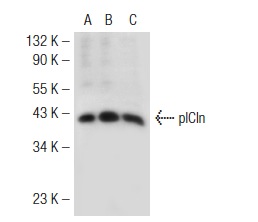
Western blot analysis of pICln expression in non-transfected 293T: (A), mouse pICln transfected 293T: (B) and Hep G2 (C) whole cell lysates.| Product Name | pICln Antibody (FL-237) |
|---|---|
| Antibody Type | Primary Antibodies |
| Antigen Alias | epitope corresponding to amino acids 1-237 representing full length pICln of human origin |
| Modification Notes | The formation of the spliceosome includes the assembly of Sm proteins in an ordered manner onto snRNAs. This process is mediated by the survival of motor neuron (SMN) protein, and is enhanced by modification of specific arginine residues in the Sm proteins to symmetrical dimethylarginines (sDMAs). sDMA modification of Sm proteins is catalyzed by the methylosome, a complex comprised of the type II methyltransferase PRMT5 (also designated Jak-binding protein 1, JBP1), pICln, and two novel factors. PRMT5 binds the Sm proteins via their arginine- and glycine-rich (RG) domains, while pICln binds the Sm domains. pICln also acts as an inhibitor of SnRNP assembly by preventing specific interactions between Sm proteins required for the formation of the Sm core. pICln is a highly conserved, ubiquitously expressed protein that localizes primarily to the cytoplasm, and may play a role as a swelling-activated anion channel or a channel regulator in addition to its function in the methylosome. The gene encoding human pICln maps to chromosome 11q14.1. |
| Clonality | Polyclonal |
|---|---|
| Isotype | IgG |
| Host Species | Rabbit |
| Tested Applications | WBIPIFELISA |
| recommended for detection of pICln of mouse, rat and human origin by WB, IP, IF and ELISA also reactive with additional species, including equine, canine, bovine and porcine: |
|
| Species Reactivity | HumanMouseRat |
| Concentration | 1mg/ml |
| Purification | Affinity purified |
| Alternative Names | epitope corresponding to amino acids 1-237 representing full length pICln of human origin |
|---|---|
| Tissue Specificity | epitope corresponding to amino acids 1-237 representing full length pICln of human origin |
| Entrez Gene | 1207 |
|---|
Application
Western blot analysis of pICln expression in non-transfected 293T: (A), mouse pICln transfected 293T: (B) and Hep G2 (C) whole cell lysates.| Application Notes | recommended for detection of pICln of mouse, rat and human origin by WB, IP, IF and ELISA also reactive with additional species, including equine, canine, bovine and porcine: |
|---|
| Form | Liquid |
|---|---|
| Storage Instructions | For short-term storage, store at 4° C. For long-term storage, aliquot and store at -20ºC or below. Avoid multiple freeze-thaw cycles. |
| Storage Buffer | phosphate buffered saline , pH 7.4, 150mM NaCl, 0.02% sodium azide and 50% glycerol. |


