Application
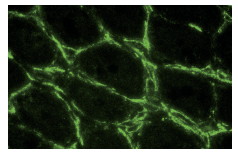
Immunofluorescence staining of normal mouse intestine frozen section showing cytoplasmic staining.Application
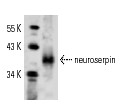
Western blot analysis of human recombinant neuroserpin.| Product Name | neuroserpin Antibody (H-90) |
|---|---|
| Antibody Type | Primary Antibodies |
| Antigen Alias | epitope corresponding to amino acids 61-150 mapping within an internal region of neuroserpin of human origin |
| Modification Notes | Neuroserpin is an axonally secreted glycoprotein in the central nervous system (CNS) that belongs to the family of protease inhibitors known as serpins (1,2). Neuroserpin is a serine-protease inhibitor (3) that forms SDS-stable complexes with tissue plasminogen activator (tPA), urokinase and plasmin, but not thrombin (2,4,5). Neuroserpin is expressed in the neocortex, the hippocampal formation, the olfactory bulb and the amygdala in the adult CNS, and it is expressed in the cerebellum, the granule cells and a subgroup of Purkinje cells in the developing embryo (2). tPA expression has been linked to "neuronal plasticity", either in the developing embryo CNS (2,4) or in cases of synpatic remodeling or long-term potentiation (6). Overexpression of tPA may promote neuronal cell death (6). Mutations in the gene which codes for neuroserpin are linked to hereditary dementia (7). Intracerebral administration of neuroserpin after stroke decreases stroke volume and diminishes the apoptotic features of the resulting ischemic penumbra (6). |
| Clonality | Polyclonal |
|---|---|
| Isotype | IgG |
| Host Species | Rabbit |
| Tested Applications | WBIPIFELISA |
| recommended for detection of neuroserpin of mouse, rat and human origin by WB, IP, IF and ELISA also reactive with additional species, including equine, canine, bovine and porcine: |
|
| Species Reactivity | HumanMouseRat |
| Concentration | 1mg/ml |
| Purification | Affinity purified |
| Alternative Names | epitope corresponding to amino acids 61-150 mapping within an internal region of neuroserpin of human origin |
|---|---|
| Tissue Specificity | epitope corresponding to amino acids 61-150 mapping within an internal region of neuroserpin of human origin |
| Entrez Gene | 5274 |
|---|
Application
Immunofluorescence staining of normal mouse intestine frozen section showing cytoplasmic staining.
Application
Western blot analysis of human recombinant neuroserpin.| Application Notes | recommended for detection of neuroserpin of mouse, rat and human origin by WB, IP, IF and ELISA also reactive with additional species, including equine, canine, bovine and porcine: |
|---|
| Form | Liquid |
|---|---|
| Storage Instructions | For short-term storage, store at 4° C. For long-term storage, aliquot and store at -20ºC or below. Avoid multiple freeze-thaw cycles. |
| Storage Buffer | phosphate buffered saline , pH 7.4, 150mM NaCl, 0.02% sodium azide and 50% glycerol. |


