Application
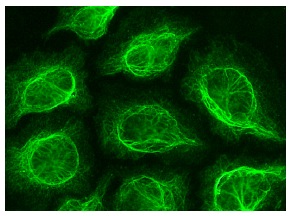
Immunofluorescence staining of methanol-fixed HeLa cells showing nuclear localization.Application
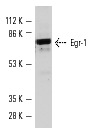
Western blot analysis of Egr-1 expression in NIH/3T3 whole cell lysate.| Product Name | Egr-1 Antibody (588) |
|---|---|
| Antibody Type | Primary Antibodies |
| Modification Notes | Egr-1, Egr-2, Egr-3 and Egr-4 are nuclear transcription factors belonging to the Egr C2H2-type zinc-finger protein family and containing three C2H2-type zinc fingers. As immediate early proteins, Egr transcription factors are rapidly induced by diverse extracellular stimuli. They are subject to tight differential control through diverse mechanisms at several levels of regulation: transcriptional; translational and posttranslational (including glycosylation, phosphorylation and redox) mechanisms; and protein-protein interaction. Egr-1 binds to the DNA sequence 5'-CGCCCCCGC-3' ((Egr-site), thereby activating transcription of target genes whose products are required for mitogenesis and differentiation. Egr-2 binds specific DNA sites located in the promoter region of HoxA4. Egr-2 defects cause congenital hypo-myelination neuropathy (also designated Charcot-Marie-Tooth disease) and Dejerine-Sottas neuropathology (also designated hereditary motor and sensory neuropathy III). Egr-3 is involved in muscle spindle development and is expressed in T cells 20 minutes following activation. Egr-4 binds to the Egr consensus motif GCGTGGGCG, functions as a transcriptional repressor, and displays autoregulatory activities, downregulating its own gene promoter in a dose dependent manner. |
| Clonality | Polyclonal |
|---|---|
| Isotype | IgG |
| Host Species | Rabbit |
| Tested Applications | WB,IP,IF,ELISA,GS,ChIP |
| recommended for detection of Egr-1 p82 of mouse, rat and human origin by WB, IP, IF and ELISA also reactive with additional species, including equine, canine, bovine and avian | |
| Species Reactivity | Human,Mouse,Rat |
| Concentration | 1mg/ml |
| Purification | Affinity purified |
| Alternative Names | epitope mapping at the C-terminus of Egr-1 of human origin |
|---|---|
| Tissue Specificity | epitope mapping at the C-terminus of Egr-1 of human origin |
| Entrez Gene | 1958 |
|---|
Application
Immunofluorescence staining of methanol-fixed HeLa cells showing nuclear localization.
Application
Western blot analysis of Egr-1 expression in NIH/3T3 whole cell lysate.| Application Notes | recommended for detection of Egr-1 p82 of mouse, rat and human origin by WB, IP, IF and ELISA also reactive with additional species, including equine, canine, bovine and avian |
|---|
| Form | Liquid |
|---|---|
| Storage Instructions | For short-term storage, store at 4° C. For long-term storage, aliquot and store at -20ºC or below. Avoid multiple freeze-thaw cycles. |
| Storage Buffer | phosphate buffered saline , pH 7.4, 150mM NaCl, 0.02% sodium azide and 50% glycerol. |


