Application
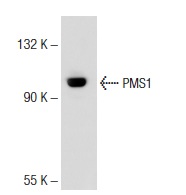
Western blot analysis of PMS1 expression in T24 whole cell lysate.Application
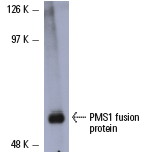
Western blot analysis of human recombinant PMS1 fusion protein.| Product Name | PMS1 Antibody (H-300) |
|---|---|
| Antibody Type | Primary Antibodies |
| Antigen Alias | epitope corresponding to amino acids 633-932 mapping at the C-terminus of PMS1 of human origin |
| Modification Notes | The finding that mutations in DNA mismatch repair genes are associated with hereditary nonpolyposis colorectal cancer (HNPCC) has resulted in considerable interest in the understanding of the mechanism of DNA mismatch repair. Initially, inherited mutations in the MSH2 and MLH1 homologs of the bacterial DNA mismatch repair genes MutS and MutL were demonstrated at high frequency in HNPCC and were shown to be associated with microsatellite instability. The demonstration that 10 to 45% of pancreatic, gastric, breast, ovarian and small cell lung cancers also display microsatellite instability has been interpreted to suggest that DNA mismatch repair is not restricted to HNPCC tumors but is a common feature in tumor initiation or progression. Two additional homologs of the prokaryotic MutL gene, designated PMS1 and PMS2, have been identified and shown to be mutated in the germline of HNPCC patients. |
| Clonality | Polyclonal |
|---|---|
| Isotype | IgG |
| Host Species | Rabbit |
| Tested Applications | WBIPIFELISA |
| recommended for detection of PMS1 of human origin by WB, IP, IF and ELISA also reactive with additional species, including equine, canine, bovine and porcine: |
|
| Species Reactivity | HumanMouseRat |
| Concentration | 1mg/ml |
| Purification | Affinity purified |
| Alternative Names | epitope corresponding to amino acids 633-932 mapping at the C-terminus of PMS1 of human origin |
|---|---|
| Tissue Specificity | epitope corresponding to amino acids 633-932 mapping at the C-terminus of PMS1 of human origin |
| Entrez Gene | 5378 |
|---|
Application
Western blot analysis of PMS1 expression in T24 whole cell lysate.
Application
Western blot analysis of human recombinant PMS1 fusion protein.| Application Notes | recommended for detection of PMS1 of human origin by WB, IP, IF and ELISA also reactive with additional species, including equine, canine, bovine and porcine: |
|---|
| Form | Liquid |
|---|---|
| Storage Instructions | For short-term storage, store at 4° C. For long-term storage, aliquot and store at -20ºC or below. Avoid multiple freeze-thaw cycles. |
| Storage Buffer | phosphate buffered saline , pH 7.4, 150mM NaCl, 0.02% sodium azide and 50% glycerol. |


