Application
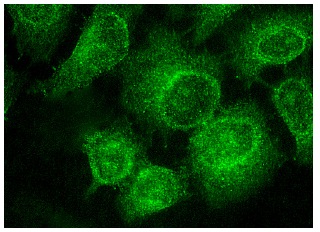
Immunofluorescence staining of methanol-fixed HeLa cells showing cytoplasmic localization.| Product Name | LKB1 Antibody (H-75) |
|---|---|
| Antibody Type | Primary Antibodies |
| Antigen Alias | epitope corresponding to amino acids 1-75 mapping at the N-terminus of LKB1 of human origin |
| Modification Notes | Peutz-Jeghers Syndrome (PJS) is a rare hereditary disease characterized by melanocytic macules lips, gastrointestinal hamartomatous polyps and an increased risk for many classes of cancer. LKB1 (also designated STK11 and PJS) has been identified as the gene mutated in PJS. LKB1 is a 433 amino acid serine/threonine kinase with strong homology to the Xenopus cytoplasmic protein kinase XEEK1 and weaker similarity to many other protein kinases. LKB1 is ubiquitously expressed and many frameshift, deletion and splicing mutations have been identified in PJS patients. Despite the increased risk of cancer for PJS patients, LKB1 does not appear to play a major role in colorectal, testicular or breast cancers. |
| Clonality | Polyclonal |
|---|---|
| Isotype | IgG |
| Host Species | Rabbit |
| Tested Applications | WBIPIFELISA |
| recommended for detection of LKB1 of mouse, rat and human origin by WB, IP, IF and ELISA also reactive with additional species, including equine, canine, bovine and avian: |
|
| Species Reactivity | HumanMouseRat |
| Concentration | 1mg/ml |
| Purification | Affinity purified |
| Alternative Names | epitope corresponding to amino acids 1-75 mapping at the N-terminus of LKB1 of human origin |
|---|---|
| Tissue Specificity | epitope corresponding to amino acids 1-75 mapping at the N-terminus of LKB1 of human origin |
| Entrez Gene | 6794 |
|---|
Application
Immunofluorescence staining of methanol-fixed HeLa cells showing cytoplasmic localization.| Application Notes | recommended for detection of LKB1 of mouse, rat and human origin by WB, IP, IF and ELISA also reactive with additional species, including equine, canine, bovine and avian: |
|---|
| Form | Liquid |
|---|---|
| Storage Instructions | For short-term storage, store at 4° C. For long-term storage, aliquot and store at -20ºC or below. Avoid multiple freeze-thaw cycles. |
| Storage Buffer | phosphate buffered saline , pH 7.4, 150mM NaCl, 0.02% sodium azide and 50% glycerol. |


