Application
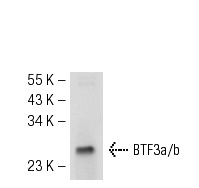
Western blot analysis of BTF3a/b expression in HeLa whole cell lysate.| Product Name | BTF3a/b Antibody (FL-206) |
|---|---|
| Antibody Type | Primary Antibodies |
| Antigen Alias | epitope corresponding to amino acids 1-206 representing full length BTF3a of human origin |
| Modification Notes | The initiation of gene transcription involves the ordered assembly of a multiprotein complex on proximal promoter elements such as the TATA box (1). In addition to RNA polymerase II, the transcription factors class II (TFII) family of proteins are required for initiation of transcription, as the first step in the formation of this initiation complex is the stable binding of TFIID to the TATA box (2). An additional TFII related protein, BTF3, does not directly associate with the proximal promoter, but rather forms a stable complex with RNA pol II and facilitates RNA pol II assembling into the complex (3,4). The BTF3 gene is ubiquitously expressed and encodes for two protein isoforms, BTF3a and BTF3b, which are produced from alternative splicing (4). The BTF3 proteins are identical except that BTF3b lacks the first 44 amino acids at the N-terminal of BTF3a. As a consequence of this deletion, BTF3b is unable to induce transcription, despite being able to bind RNA pol II (5). Additionally, BTF3a and BTF3b associate with the widely expressed protein kinase CK2 (6). CK2 phosphorylates BTF3a, as well as TFIIB, and is required for the efficient transcription of the tRNA and 55 rRNA genes by RNA pol III (7). |
| Clonality | Polyclonal |
|---|---|
| Isotype | IgG |
| Host Species | Rabbit |
| Tested Applications | WBIPIFELISA |
| recommended for detection of BTF3a and BTF3b of mouse, rat and human origin by WB, IP, IF and ELISA also reactive with additional species, including equine: |
|
| Species Reactivity | HumanMouseRat |
| Concentration | 1mg/ml |
| Purification | Affinity purified |
| Alternative Names | epitope corresponding to amino acids 1-206 representing full length BTF3a of human origin |
|---|---|
| Tissue Specificity | epitope corresponding to amino acids 1-206 representing full length BTF3a of human origin |
| Entrez Gene | 689 |
|---|
Application
Western blot analysis of BTF3a/b expression in HeLa whole cell lysate.| Application Notes | recommended for detection of BTF3a and BTF3b of mouse, rat and human origin by WB, IP, IF and ELISA also reactive with additional species, including equine: |
|---|
| Form | Liquid |
|---|---|
| Storage Instructions | For short-term storage, store at 4° C. For long-term storage, aliquot and store at -20ºC or below. Avoid multiple freeze-thaw cycles. |
| Storage Buffer | phosphate buffered saline , pH 7.4, 150mM NaCl, 0.02% sodium azide and 50% glycerol. |


