Application
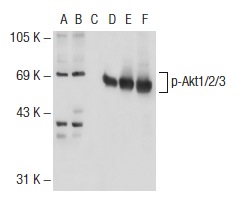
Antibodies tested include p-Akt1/2/3 (Thr 308)-R: (A, B, C) and Akt1/2/3 (H-136): (D, E, F).Application
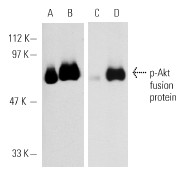
Antibodies tested include Akt1 (B-1): (A,B) and p-Akt1/2/3 (Thr 308)-R: (C,D).Application
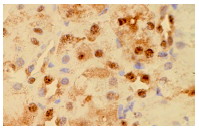
Immunoperoxidase staining of formalin fixed, paraffin-embedded mouse kidney tissue showing nuclear localization.| Product Name | Akt1 Antibody (B-1) FITC |
|---|---|
| Antibody Type | Primary Antibodies |
| Antigen Alias | raised against a short amino acid sequence containing phosphorylated Thr 308 of Akt1 of human origin. |
| Modification | Phosphoralated |
| Modification Notes | The serine/threonine kinase Akt family contains several members, including Akt1 (also designated PKB or RacPK), Akt2 (also designated PKB∫ or RacPK-∫) and Akt 3 (also designated PKB© or thyoma viral proto-oncogene 3), which exhibit sequence homology with the protein kinase A and C families and are encoded by the c-Akt proto-oncogene. All members of the Akt family have a Pleckstrin homology domain. Akt1 and Akt2 are activated by PDGF stimulation. This activation is dependent on PDGFR-∫ tyrosine residues 740 and 751, which bind the subunit of the phosphatidylinositol 3-kinase (PI 3-kinase) complex. Activation of Akt1 by insulin or insulin-growth factor-1(IGF-1) results in phosphorylation of both Thr 308 and Ser 473. Akt proteins become phosphorylated and activated in insulin/IGF-1-stimulated cells by an upstream kinase(s), and the activation of Akt1 and Akt2 is inhibited by the PI kinase inhibitor Wortmannin. Taken together, this data strongly suggests that the protein signals downstream of the PI kinases. Akt3 is phosphorylated on a serine residue in response to insulin. However, the activation of Akt3 by insulin is inhibited by prior activation of protein kinase C via a mechanism that does not require the presence of the PH domain. Akt3 is expressed in 3T3-L1 fibroblasts, adipocytes and skeletal muscle and may be involved in various biological processes, including adipocyte and muscle differentiation, glycogen synthesis, glucose uptake, apoptosis and cellular proliferation. |
| Clonality | Polyclonal |
|---|---|
| Isotype | IgG |
| Host Species | Rabbit |
| Tested Applications | WBIPIFIHCELISA |
| recommended for detection of Thr 308 phosphorylated Akt1 and correspondingly Thr 309 phosphorylated Akt2 and correspondingly Thr 305 phosphorylated Akt3 of mouse, rat and human origin by WB, IP, IF, IHC(P) and ELISA also reactive with additional species, including equine and avian: |
|
| Species Reactivity | HumanMouseRat |
| Concentration | 1mg/ml |
| Purification | Affinity purified |
| Alternative Names | raised against a short amino acid sequence containing phosphorylated Thr 308 of Akt1 of human origin. |
|---|---|
| Tissue Specificity | raised against a short amino acid sequence containing phosphorylated Thr 308 of Akt1 of human origin. |
Application
Antibodies tested include p-Akt1/2/3 (Thr 308)-R: (A, B, C) and Akt1/2/3 (H-136): (D, E, F).
Application
Antibodies tested include Akt1 (B-1): (A,B) and p-Akt1/2/3 (Thr 308)-R: (C,D).
Application
Immunoperoxidase staining of formalin fixed, paraffin-embedded mouse kidney tissue showing nuclear localization.| Application Notes | recommended for detection of Thr 308 phosphorylated Akt1 and correspondingly Thr 309 phosphorylated Akt2 and correspondingly Thr 305 phosphorylated Akt3 of mouse, rat and human origin by WB, IP, IF, IHC(P) and ELISA also reactive with additional species, including equine and avian: |
|---|
| Form | Liquid |
|---|---|
| Storage Instructions | For short-term storage, store at 4° C. For long-term storage, aliquot and store at -20ºC or below. Avoid multiple freeze-thaw cycles. |
| Storage Buffer | phosphate buffered saline , pH 7.4, 150mM NaCl, 0.02% sodium azide and 50% glycerol. |


