Application
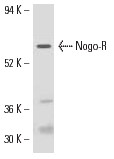
Western blot analysis of Nogo-R expression in rat brain tissue extract.| Product Name | Nogo-R Antibody (H-120) |
|---|---|
| Antibody Type | Primary Antibodies |
| Antigen Alias | epitope corresponding to amino acids 31-150 mapping near the N-terminus of Nogo-R of human origin |
| Modification Notes | CNS white matter is selectively inhibitory for axonal outgrowth. Nogo is an oligodendrocyte-specific member of the reticulon family and is a component of CNS white matter that prevents axonal regeneration in the adult CNS. Nogo is expressed by oligodendrocytes and associates primarily with the endoplasmic reticulum. The extracellular domain of Nogo, designated Nogo-66 inhibits axonal extension, but does not alter non-neuronal cell morphology. Expression of a brain-specific, leucine-rich-repeat protein with high affinity for Nogo-66, the Nogo-66 receptor (Nogo-R), is sufficient to impart Nogo-66 axonal inhibition to unresponsive neurons. Disruption of the interaction between Nogo-66 and Nogo-R potentially provides for enhanced recovery after human CNS injury. Nogo-R is widely expressed in the brain, with the highest levels of expression in the gray matter of the CNS. In addition, low levels of Nogo-R mRNA are expressed in heart and kidney. The gene encoding Nogo-R maps to human chromosome 22q11. |
| Clonality | Polyclonal |
|---|---|
| Isotype | IgG |
| Host Species | Rabbit |
| Tested Applications | WBIPIFELISA |
| recommended for detection of Nogo-R of mouse, rat and human origin by WB, IP, IF and ELISA also reactive with additional species, including equine, canine, bovine and porcine: |
|
| Species Reactivity | HumanMouseRat |
| Concentration | 1mg/ml |
| Purification | Affinity purified |
| Alternative Names | epitope corresponding to amino acids 31-150 mapping near the N-terminus of Nogo-R of human origin |
|---|---|
| Tissue Specificity | epitope corresponding to amino acids 31-150 mapping near the N-terminus of Nogo-R of human origin |
| Entrez Gene | 65078 |
|---|
Application
Western blot analysis of Nogo-R expression in rat brain tissue extract.| Application Notes | recommended for detection of Nogo-R of mouse, rat and human origin by WB, IP, IF and ELISA also reactive with additional species, including equine, canine, bovine and porcine: |
|---|
| Form | Liquid |
|---|---|
| Storage Instructions | For short-term storage, store at 4° C. For long-term storage, aliquot and store at -20ºC or below. Avoid multiple freeze-thaw cycles. |
| Storage Buffer | phosphate buffered saline , pH 7.4, 150mM NaCl, 0.02% sodium azide and 50% glycerol. |


