Application
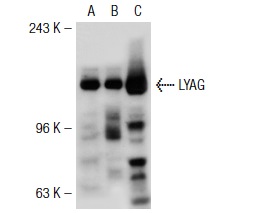
Western blot analysis of LYAG expression in non-transfected 293T: (A), mouse LYAG transfected 293T: (B) and COLO 320DM (C) whole cell lysates.| Product Name | LYAG Antibody (M-63) |
|---|---|
| Antibody Type | Primary Antibodies |
| Antigen Alias | epitope corresponding to amino acids 129-191 mapping near the N-terminus of LYAG of mouse origin |
| Modification Notes | Lysosomal a-glucosidase (LYAG), also designated acid a-glucosidase or acid maltase, is essential for the degradation of glycogen to glucose in lysosomes. LYAG is a protein belonging to the glycosyl hydrolase 31 family and resides soley in the lysosome. After translation, LYAG undergoes proteolytic processing to form two lengths of lysosomal a-glucosidase, and both N-terminal and C-terminal processing occur. Conduritol B epoxide (CBE) is a competitive inhibitor of LYAG. Defects in GAA, the gene encoding for LYAG, may cause Pompe disease, an autosomal recessive disorder characterized by cardiorespiratory insufficiency and glycogen accumulation in muscle tissues, causing muscular weakness. Mutations on the LYAG gene also cause glycogen storage disease II (GSD-II). |
| Clonality | Polyclonal |
|---|---|
| Isotype | IgG |
| Host Species | Rabbit |
| Tested Applications | WBIPIFELISA |
| recommended for detection of precursor and mature Lysosomal alpha-glucosidase (LYAG) of mouse, rat and, to a lesser extent, human origin by WB, IP, IF and ELISA: |
|
| Species Reactivity | HumanMouseRat |
| Concentration | 1mg/ml |
| Purification | Affinity purified |
| Alternative Names | epitope corresponding to amino acids 129-191 mapping near the N-terminus of LYAG of mouse origin |
|---|---|
| Tissue Specificity | epitope corresponding to amino acids 129-191 mapping near the N-terminus of LYAG of mouse origin |
| Entrez Gene | 2548 |
|---|
Application
Western blot analysis of LYAG expression in non-transfected 293T: (A), mouse LYAG transfected 293T: (B) and COLO 320DM (C) whole cell lysates.| Application Notes | recommended for detection of precursor and mature Lysosomal alpha-glucosidase (LYAG) of mouse, rat and, to a lesser extent, human origin by WB, IP, IF and ELISA: |
|---|
| Form | Liquid |
|---|---|
| Storage Instructions | For short-term storage, store at 4° C. For long-term storage, aliquot and store at -20ºC or below. Avoid multiple freeze-thaw cycles. |
| Storage Buffer | phosphate buffered saline , pH 7.4, 150mM NaCl, 0.02% sodium azide and 50% glycerol. |


