Application
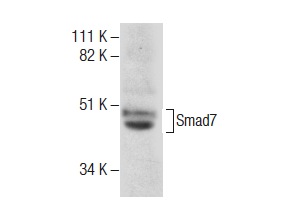
Western blot analysis of Smad7 expression in HeLa whole cell lysate.Application
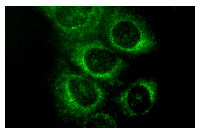
Immunofluorescence staining of methanol-fixed A549 cells showing perinuclear localization.| Product Name | Smad7 Antibody (H-79) |
|---|---|
| Antibody Type | Primary Antibodies |
| Antigen Alias | epitope corresponding to amino acids 319-397 of Smad7 of human origin |
| Modification Notes | Smad proteins, the mammalian homologs of the Drosophila Mothers against dpp (Mad) have been implicated as downstream effectors of TGF∫/BMP signaling. Smad1 (also designated Madr1 or JV4-1), Smad5 and mammalian Smad8 (also designated Smad9 or MADH6) are effectors of BMP2 and BMP4 function while Smad2 (also designated Madr2 or JV18-1) and Smad3 are involved in TGFß and activin-mediated growth modulation. Smad4 (also designated DPC4) has been shown to mediate all of the above activities through interaction with various Smad family members. Smad6 and Smad7 regulate the response to activin/TGFß signaling by interfering with TGFß-mediated phosphorylation of other Smad family members. |
| Clonality | Polyclonal |
|---|---|
| Isotype | IgG |
| Host Species | Rabbit |
| Tested Applications | WBIPIFELISAGSChIP |
| recommended for detection of Smad7 of mouse, rat and human origin by WB, IP, IF and ELISA also reactive with additional species, including equine, canine, bovine, porcine and avian: |
|
| Species Reactivity | HumanMouseRat |
| Concentration | 1mg/ml |
| Purification | Affinity purified |
| Alternative Names | epitope corresponding to amino acids 319-397 of Smad7 of human origin |
|---|---|
| Tissue Specificity | epitope corresponding to amino acids 319-397 of Smad7 of human origin |
| Entrez Gene | 4092 |
|---|
Application
Western blot analysis of Smad7 expression in HeLa whole cell lysate.
Application
Immunofluorescence staining of methanol-fixed A549 cells showing perinuclear localization.| Application Notes | recommended for detection of Smad7 of mouse, rat and human origin by WB, IP, IF and ELISA also reactive with additional species, including equine, canine, bovine, porcine and avian: |
|---|
| Form | Liquid |
|---|---|
| Storage Instructions | For short-term storage, store at 4° C. For long-term storage, aliquot and store at -20ºC or below. Avoid multiple freeze-thaw cycles. |
| Storage Buffer | phosphate buffered saline , pH 7.4, 150mM NaCl, 0.02% sodium azide and 50% glycerol. |


