Application
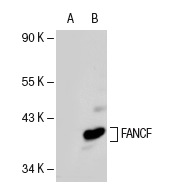
Western blot analysis of FANCF expression in non-transfected: (A) and human FANCF transfected: (B) 293T whole cell lysates.| Product Name | FANCF Antibody (H-310) |
|---|---|
| Antibody Type | Primary Antibodies |
| Antigen Alias | epitope corresponding to amino acids 41-350 of FANCF of human origin |
| Modification Notes | Fanconi anemia (FA) is an autosomal recessive disorder characterized by bone marrow failure, birth defects, and chromosomal instability. At the cellular level, FA is characterized by spontaneous chromosomal breakage and a unique hypersensitivity to DNA cross-linking agents. At least 8 complementation groups (A-G) have been identified and 6 FA genes (for subtypes A, C, D2, E, F, and G) have been cloned. The FA proteins lack sequence homologies or motifs that could point to a molecular function. Phosphorylation of FANC (Fanconi anemia complementation group) proteins is thought to be important for the function of the FA pathway. FA proteins are encoded by 6 cloned FA genes (FANCA, FANCC, FANCD2, FANCE, FANCF, and FANCG) and cooperate in a common pathway, culminating in the monoubiquitination of FANCD2 protein and colocalization of FANCD2 and BRCA1 proteins in nuclear foci. FANCF protein is required for FANCD2 activation and appears to stabilize other subunits of the complex. The human FANCF gene maps to chromosome 11p15 and encodes a nuclear protein with homology to the prokaryotic RNA-binding protein ROM. |
| Clonality | Polyclonal |
|---|---|
| Isotype | IgG |
| Host Species | Rabbit |
| Tested Applications | WBIPIFELISA |
| recommended for detection of FANCF of human origin by WB, IP, IF and ELISA: |
|
| Species Reactivity | HumanMouseRat |
| Concentration | 1mg/ml |
| Purification | Affinity purified |
| Alternative Names | epitope corresponding to amino acids 41-350 of FANCF of human origin |
|---|---|
| Tissue Specificity | epitope corresponding to amino acids 41-350 of FANCF of human origin |
| Entrez Gene | 2188 |
|---|
Application
Western blot analysis of FANCF expression in non-transfected: (A) and human FANCF transfected: (B) 293T whole cell lysates.| Application Notes | recommended for detection of FANCF of human origin by WB, IP, IF and ELISA: |
|---|
| Form | Liquid |
|---|---|
| Storage Instructions | For short-term storage, store at 4° C. For long-term storage, aliquot and store at -20ºC or below. Avoid multiple freeze-thaw cycles. |
| Storage Buffer | phosphate buffered saline , pH 7.4, 150mM NaCl, 0.02% sodium azide and 50% glycerol. |


