Application
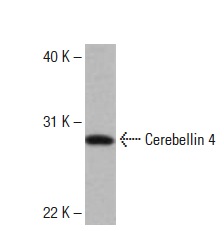
Western blot analysis of Cerebellin 4 expression in HeLa whole cell lysate.| Product Name | Cerebellin 4 Antibody (Y-23) |
|---|---|
| Antibody Type | Primary Antibodies |
| Antigen Alias | recommended for detection of Cerebellin 4 of mouse, rat and human origin by WB, IP and ELISA |
| Modification Notes | Cerebellin (CER), which was originally isolated from rat cerebellum, is a hexadecapeptide derived from a larger precursor called Cerebellin 1, also designated precerebellin 1 or Cbln1. Four propeptides, Cerebellin 1, Cerebellin 2 (Cbln2), Cerebellin 3 (Cbln3) and Cerebellin 4 (Cbln4), comprise the precerebellin subfamily within the C1q protein family. Cerebellin family members act as transneuronal regulators of synapse development and synaptic plasticity in various brain regions. Cerebellin and its metabolite, des-Ser(1)Cer, are also expressed in several extra-cerebellar tissues, including adrenal gland. Cerebellin 1, 2 and 3 assemble into homomeric and heteromeric complexes, thereby influencing each other’s degradation and secretion. Cerebellin 3 is not able to form homomeric complexes, and can only be secreted upon forming a heteromeric complex with Cerebellin 1. Decreased concentrations of Cerebellin have been found in the brain of patients with olivopontocerebellar atrophy (OPCA) and Shy-Drager syndrome, suggesting a role for Cerebellin in the pathology of these diseases. |
| Clonality | Polyclonal |
|---|---|
| Isotype | IgG |
| Host Species | Rabbit |
| Tested Applications | WBIPELISA |
| WB:1:500~1:2000 IP:1:100~1:500 Notes:Optimal dilutions/concentrations should be determined by the researcher. |
|
| Species Reactivity | HumanMouseRat |
| Concentration | 1mg/ml |
| Purification | Affinity purified |
| Alternative Names | recommended for detection of Cerebellin 4 of mouse rat and human origin by WB IP and ELISA |
|---|---|
| Tissue Specificity | recommended for detection of Cerebellin 4 of mouse, rat and human origin by WB, IP and ELISA |
| Entrez Gene | 140689 |
|---|
Application
Western blot analysis of Cerebellin 4 expression in HeLa whole cell lysate.| Application Notes | WB:1:500~1:2000 IP:1:100~1:500 Notes:Optimal dilutions/concentrations should be determined by the researcher. |
|---|
| Form | Liquid |
|---|---|
| Storage Instructions | For short-term storage, store at 4° C. For long-term storage, aliquot and store at -20ºC or below. Avoid multiple freeze-thaw cycles. |
| Storage Buffer | phosphate buffered saline , pH 7.4, 150mM NaCl, 0.02% sodium azide and 50% glycerol. |


