Application
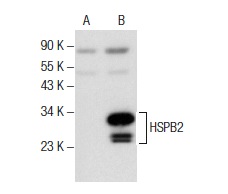
Western blot analysis of HSPB2 expression in non-transfected (A) and human HSPB2 transfected (B) whole cell lysates.| Product Name | HSPB2 Antibody (H-75) |
|---|---|
| Antibody Type | Primary Antibodies |
| Antigen Alias | epitope corresponding to amino acids 36-110 mapping within an internal region of HSPB2 of human origin |
| Modification Notes | The heat shock proteins (HSPs) comprise a group of highly conserved, abundantly expressed proteins with diverse functions, including the assembly and sequestering of multi-protein complexes, transportation of nascent polypeptide chains across cellular membranes and regulation of protein folding. HSPB2 (heat shock 27 kDa protein 2), also known as HSP 27 or MKBP, is a 182 amino acid protein that belongs to the heat shock protein family and is expressed preferentially in heart and skeletal muscle. Localized to mitochondria, HSPB2 functions as an ATP-dependent chaperone protein that plays a role in the refolding of denatured proteins and may also interact with the Actin cytoskeleton and prevent apoptotic cell death. HSPB2 is abundantly expressed in several cancer cell lines, suggesting that HSPB2 may be an important factor in tumor transformation and metastasis. |
| Clonality | Polyclonal |
|---|---|
| Isotype | IgG |
| Host Species | Rabbit |
| Tested Applications | WBIPIFELISA |
| recommended for detection of HSPB2 of mouse, rat and human origin by WB, IP, IF and ELISA also reactive with additional species, including equine, canine, bovine and porcine: |
|
| Species Reactivity | HumanMouseRat |
| Concentration | 1mg/ml |
| Purification | Affinity purified |
| Alternative Names | epitope corresponding to amino acids 36-110 mapping within an internal region of HSPB2 of human origin |
|---|---|
| Tissue Specificity | epitope corresponding to amino acids 36-110 mapping within an internal region of HSPB2 of human origin |
| Entrez Gene | 3316 |
|---|
Application
Western blot analysis of HSPB2 expression in non-transfected (A) and human HSPB2 transfected (B) whole cell lysates.| Application Notes | recommended for detection of HSPB2 of mouse, rat and human origin by WB, IP, IF and ELISA also reactive with additional species, including equine, canine, bovine and porcine: |
|---|
| Form | Liquid |
|---|---|
| Storage Instructions | For short-term storage, store at 4° C. For long-term storage, aliquot and store at -20ºC or below. Avoid multiple freeze-thaw cycles. |
| Storage Buffer | phosphate buffered saline , pH 7.4, 150mM NaCl, 0.02% sodium azide and 50% glycerol. |


