Application
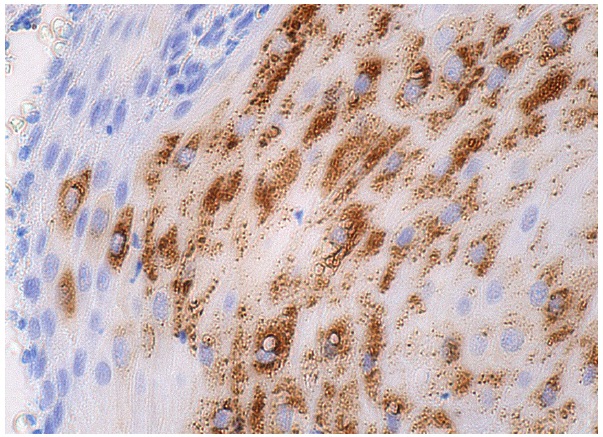
Immunoperoxidase staining of formalin fixed, paraffin-embedded human esophagus tissue showing cytoplasmic staining of squamous epithelial cells.| Product Name | GRPR Antibody (M-50) |
|---|---|
| Antibody Type | Primary Antibodies |
| Antigen Alias | epitope corresponding to amino acids 1-50 mapping at the N-terminus of GRPR of mouse origin |
| Modification Notes | Gastrin-Releasing Peptide (GRP) stimulates the release of gastrin as well as other gastrointestinal hormones in addition to acting as an autocrine growth factor for certain cell types. The human GRP receptor (GRPR) gene maps to chromosome Xp21.2-p22.3 and encodes a seven transmembrane domain protein. Whereas normal human pancreas and stomach express GRPR, normal lung, colon and prostate do not. Well-differentiated colon tumors coexpress GRP and GRPR. Prostate carcinoma also expresses GRPR. Following exposure to nicotine, human lung fibroblasts increase expression of GRPR. Aberrent GRPR expression occurs more frequently in female normal lung than male normal lung, and may account for the increased susceptibility of women to tobacco-induced lung cancer. |
| Clonality | Polyclonal |
|---|---|
| Isotype | IgG |
| Host Species | Rabbit |
| Tested Applications | WBIPIFELISA |
| recommended for detection of GRPR of mouse and rat origin by WB, IP, IF and ELISA: |
|
| Species Reactivity | HumanMouseRat |
| Concentration | 1mg/ml |
| Purification | Affinity purified |
| Alternative Names | epitope corresponding to amino acids 1-50 mapping at the N-terminus of GRPR of mouse origin |
|---|---|
| Tissue Specificity | epitope corresponding to amino acids 1-50 mapping at the N-terminus of GRPR of mouse origin |
| Entrez Gene | 14829 |
|---|
Application
Immunoperoxidase staining of formalin fixed, paraffin-embedded human esophagus tissue showing cytoplasmic staining of squamous epithelial cells.| Application Notes | recommended for detection of GRPR of mouse and rat origin by WB, IP, IF and ELISA: |
|---|
| Form | Liquid |
|---|---|
| Storage Instructions | For short-term storage, store at 4° C. For long-term storage, aliquot and store at -20ºC or below. Avoid multiple freeze-thaw cycles. |
| Storage Buffer | phosphate buffered saline , pH 7.4, 150mM NaCl, 0.02% sodium azide and 50% glycerol. |


