Application
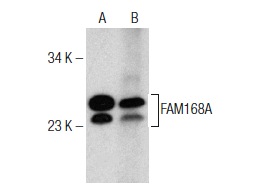
Western blot analysis of FAM168A expression in Jurkat whole cell lysate (A) and mouse spleen tissue extract (B).| Product Name | FAM168A Antibody (E-13) |
|---|---|
| Antibody Type | Primary Antibodies |
| Antigen Alias | epitope mapping within an internal region of FAM168A of human origin |
| Modification Notes | FAM168A (family with sequence similarity 168, member A) is a 244 amino acid protein that exists as three alternatively spliced isoforms and is encoded by a gene that maps to human chromosome 11, which makes up around 4% of human genomic DNA and is considered a gene and disease association dense chromosome. The chromosome 11 encoded Atm gene is important for regulation of cell cycle arrest and apoptosis following double strand DNA breaks. Atm mutation leads to the disorder known as ataxia-telangiectasia. The blood disorders Sickle cell anemia and ∫ thalassemia are caused by HBB gene mutations. Wilms' tumors, WAGR syndrome and Denys-Drash syndrome are associated with mutations of the WT1 gene. Jervell and Lange-Nielsen syndrome, Jacobsen syndrome, Niemann-Pick disease, hereditary angioedema and Smith-Lemli-Opitz syndrome are also associated with defects in chromosome 11. |
| Clonality | Polyclonal |
|---|---|
| Isotype | IgG |
| Host Species | Rabbit |
| Tested Applications | WBIPIFELISA |
| recommended for detection of FAM168A of mouse, rat and human origin by WB, IP, IF and ELISA non cross-reactive with other KIAA family members also reactive with additional species, including equine, canine, bovine, porcine and avian: |
|
| Species Reactivity | HumanMouseRat |
| Concentration | 1mg/ml |
| Purification | Affinity purified |
| Alternative Names | epitope mapping within an internal region of FAM168A of human origin |
|---|---|
| Tissue Specificity | epitope mapping within an internal region of FAM168A of human origin |
| Entrez Gene | 23201 |
|---|
Application
Western blot analysis of FAM168A expression in Jurkat whole cell lysate (A) and mouse spleen tissue extract (B).| Application Notes | recommended for detection of FAM168A of mouse, rat and human origin by WB, IP, IF and ELISA non cross-reactive with other KIAA family members also reactive with additional species, including equine, canine, bovine, porcine and avian: |
|---|
| Form | Liquid |
|---|---|
| Storage Instructions | For short-term storage, store at 4° C. For long-term storage, aliquot and store at -20ºC or below. Avoid multiple freeze-thaw cycles. |
| Storage Buffer | phosphate buffered saline , pH 7.4, 150mM NaCl, 0.02% sodium azide and 50% glycerol. |


