Application
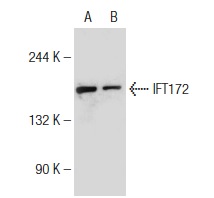
Western blot analysis of IFT172 expression in A549 (A) and NTERA-2 cl.D1 (B) whole cell lysates.| Product Name | IFT172 Antibody (N-14) |
|---|---|
| Antibody Type | Primary Antibodies |
| Antigen Alias | epitope mapping near the N-terminus of IFT172 of human origin |
| Modification Notes | Intraflagellar transport is mediated by a variety of intraflagellar transport proteins (IFTs) that work in tandem to mediate ciliary and flagellar process assembly. Endogenous IFT proteins are most highly expressed within the inner segment, around the basal body, and within the outer segment.Additionally, IFT proteins are localized in discrete particles along the entire length of the axoneme. IFT proteins are divided into two subcomplexes, A and B, which contain at least 6 or 11 subunits, respectively. IFT-A proteins are associated with retrograde transport, whereas IFT-B proteins are thought to be involved in structure because, in their absence, cilia and flagella may be truncated, or completely absent. IFT172 (intraflagellar transport 172), also known as SLB, wim or osm-1, is a 1,749 amino acid protein that belongs to the IFT172 family and localizes to the cilium. Containing fourteen TPR repeats and nine WD repeats, IFT172 is required for the maintenance and formation of cilia. IFT172 plays an indirect role in Shh signaling, with cilia being required for all activity of the hedgehog pathway. |
| Clonality | Polyclonal |
|---|---|
| Isotype | IgG |
| Host Species | Rabbit |
| Tested Applications | WBIPIFELISA |
| recommended for detection of IFT172 of mouse, rat and human origin by WB, IP, IF and ELISA non cross-reactive with other IFT172 family members also reactive with additional species, including equine, canine and porcine: |
|
| Species Reactivity | HumanMouseRat |
| Concentration | 1mg/ml |
| Purification | Affinity purified |
| Alternative Names | epitope mapping near the N-terminus of IFT172 of human origin |
|---|---|
| Tissue Specificity | epitope mapping near the N-terminus of IFT172 of human origin |
| Entrez Gene | 26160 |
|---|
Application
Western blot analysis of IFT172 expression in A549 (A) and NTERA-2 cl.D1 (B) whole cell lysates.| Application Notes | recommended for detection of IFT172 of mouse, rat and human origin by WB, IP, IF and ELISA non cross-reactive with other IFT172 family members also reactive with additional species, including equine, canine and porcine: |
|---|
| Form | Liquid |
|---|---|
| Storage Instructions | For short-term storage, store at 4° C. For long-term storage, aliquot and store at -20ºC or below. Avoid multiple freeze-thaw cycles. |
| Storage Buffer | phosphate buffered saline , pH 7.4, 150mM NaCl, 0.02% sodium azide and 50% glycerol. |


