Application
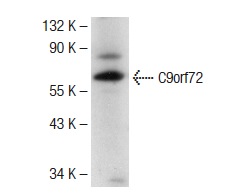
Western blot analysis of C9orf72 expression in SK-N-SH whole cell lysate.| Product Name | C9orf72 Antibody (S-14) |
|---|---|
| Antibody Type | Primary Antibodies |
| Antigen Alias | epitope mapping within an internal region of C9orf72 of human origin |
| Modification Notes | Chromosome 9 consists of about 145 million bases and 4% of the human genome and encodes nearly 900 genes. Considered to play a role in gender determination, deletion of the distal portion of 9p can lead to development of male to female sex reversal, the phenotype of a female with a male X,Y genotype. Hereditary hemorrhagic telangiectasia, which is characterized by harmful vascular defects, is associated with the chromosome 9 gene encoding endoglin protein, ENG. Familial dysautonomia is also associated with chromosome 9 though through the gene IKBKAP. Notably, chromosome 9 encompasses the largest interferon family gene cluster. Chromosome 9 is partnered with chromosome 22 in the translocation leading to the aberrant production of BCR-ABL fusion protein often found in leukemias. The C9orf72 gene product has been provisionally designated C9orf72 pending further characterization. There are two isoforms of C9orf72 that are produced as a result of alternative splicing events. |
| Clonality | Polyclonal |
|---|---|
| Isotype | IgG |
| Host Species | Rabbit |
| Tested Applications | WBIPIFELISA |
| recommended for detection of C9orf72 of human origin and 3110043O21Rik of mouse origin of mouse, rat and human origin by WB, IP, IF and ELISA non cross-reactive with other C9orf family members also reactive with additional species, including equine, canine and avian: |
|
| Species Reactivity | HumanMouseRat |
| Concentration | 1mg/ml |
| Purification | Affinity purified |
| Alternative Names | epitope mapping within an internal region of C9orf72 of human origin |
|---|---|
| Tissue Specificity | epitope mapping within an internal region of C9orf72 of human origin |
| Entrez Gene | 203228 |
|---|
Application
Western blot analysis of C9orf72 expression in SK-N-SH whole cell lysate.| Application Notes | recommended for detection of C9orf72 of human origin and 3110043O21Rik of mouse origin of mouse, rat and human origin by WB, IP, IF and ELISA non cross-reactive with other C9orf family members also reactive with additional species, including equine, canine and avian: |
|---|
| Form | Liquid |
|---|---|
| Storage Instructions | For short-term storage, store at 4° C. For long-term storage, aliquot and store at -20ºC or below. Avoid multiple freeze-thaw cycles. |
| Storage Buffer | phosphate buffered saline , pH 7.4, 150mM NaCl, 0.02% sodium azide and 50% glycerol. |


