Application
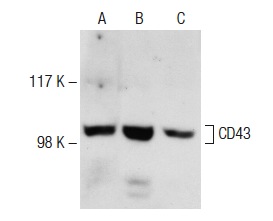
Western blot analysis of CD43 expression in Jurkat (A), K-562 (B) and Ramos (C) whole cell lysates.| Product Name | CD43 Antibody (H-300) |
|---|---|
| Antibody Type | Primary Antibodies |
| Antigen Alias | epitope corresponding to amino acids 101-400 mapping at the C-terminus of CD43 of human origin |
| Modification Notes | Over 100 cell surface markers have been identified through the use of monoclonal antibodies. Many of these markers have proven useful in identifying a specific subpopulation of cells within a mixed colony. Accordingly, these molecules have been assigned a “cluster of differentiation” (CD) designation. CD43 is the major O-glycosylated cell-surface associated sialoglycoprotein found on the cell membranes of leukocytes. It is a member of the surface mucin family which plays a central role in cellular adhesion tumor progression. Also called leukosialin, CD43 is best known as a marker for identifying normal and neoplastic T cells and a subset of neoplastic B cells within tissues. CD43 is thought to function as a negative regulator of cellular adhesion. |
| Clonality | Polyclonal |
|---|---|
| Isotype | IgG |
| Host Species | Rabbit |
| Tested Applications | WBIPIFELISA |
| recommended for detection of CD43 of human and, to a lesser extent, mouse and rat origin by WB, IP, IF and ELISA: |
|
| Species Reactivity | HumanMouseRat |
| Concentration | 1mg/ml |
| Purification | Affinity purified |
| Alternative Names | epitope corresponding to amino acids 101-400 mapping at the C-terminus of CD43 of human origin |
|---|---|
| Tissue Specificity | epitope corresponding to amino acids 101-400 mapping at the C-terminus of CD43 of human origin |
| Entrez Gene | 6693 |
|---|
Application
Western blot analysis of CD43 expression in Jurkat (A), K-562 (B) and Ramos (C) whole cell lysates.| Application Notes | recommended for detection of CD43 of human and, to a lesser extent, mouse and rat origin by WB, IP, IF and ELISA: |
|---|
| Form | Liquid |
|---|---|
| Storage Instructions | For short-term storage, store at 4° C. For long-term storage, aliquot and store at -20ºC or below. Avoid multiple freeze-thaw cycles. |
| Storage Buffer | phosphate buffered saline , pH 7.4, 150mM NaCl, 0.02% sodium azide and 50% glycerol. |


