Application
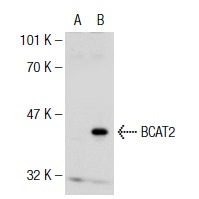
Western blot analysis of BCAT2 expression in non-transfected: (A) and human BCAT2 transfected: (B) 293T whole cell lysates.| Product Name | BCAT2 Antibody (H-210) |
|---|---|
| Antibody Type | Primary Antibodies |
| Antigen Alias | epitope corresponding to amino acids 144-353 mapping within an internal region of BCAT2 of human origin |
| Modification Notes | Class-IV pyridoxal-phosphate-dependent aminotransferase family members ECA39 and BCAT2 are both enzymes that catalyze the first reaction in the catabolism of the essential branched chain amino acids valine, leucine and isoleucine. ECA39, also known as BCAT1 (branched-chain-amino-acid aminotransferase 1, cytosolic) is localized to the cytoplasm where it forms a homodimer. ECA39 is expressed in the brain and kidney during embryogenesis and is overexpressed in c-Myc induced tumors. BCAT2 (branched-chain-amino-acid aminotransferase 2, mitochondrial), also known as placental protein 18 (PP18), is expressed as two isoforms produced by alternative splicing. The first isoform of BCAT2, designated BCAT2A, is expressed in the mitochondrion, while the second isoform, designated BCAT2B, is expressed in the cytoplasm. Ubiquitously expressed, BCAT2 is also thought to act as a transporter of branched chain alpha-keto acids. |
| Clonality | Polyclonal |
|---|---|
| Isotype | IgG |
| Host Species | Rabbit |
| Tested Applications | WBIPIFELISA |
| recommended for detection of BCAT2 of mouse, rat and human origin by WB, IP, IF and ELISA also reactive with additional species, including equine, canine and bovine: |
|
| Species Reactivity | HumanMouseRat |
| Concentration | 1mg/ml |
| Purification | Affinity purified |
| Alternative Names | epitope corresponding to amino acids 144-353 mapping within an internal region of BCAT2 of human origin |
|---|---|
| Tissue Specificity | epitope corresponding to amino acids 144-353 mapping within an internal region of BCAT2 of human origin |
Application
Western blot analysis of BCAT2 expression in non-transfected: (A) and human BCAT2 transfected: (B) 293T whole cell lysates.| Application Notes | recommended for detection of BCAT2 of mouse, rat and human origin by WB, IP, IF and ELISA also reactive with additional species, including equine, canine and bovine: |
|---|
| Form | Liquid |
|---|---|
| Storage Instructions | For short-term storage, store at 4° C. For long-term storage, aliquot and store at -20ºC or below. Avoid multiple freeze-thaw cycles. |
| Storage Buffer | phosphate buffered saline , pH 7.4, 150mM NaCl, 0.02% sodium azide and 50% glycerol. |


