Application
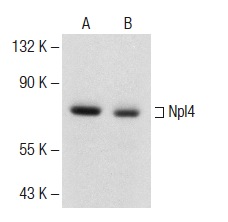
Western blot analysis of Npl4 expression in SK-N-MC (A) and SH-SY5Y (B) whole cell lysates.| Product Name | Npl4 Antibody (H-300) |
|---|---|
| Antibody Type | Primary Antibodies |
| Antigen Alias | epitope corresponding to amino acids 1-300 mapping at the N-terminus of Npl4 of human origin |
| Modification Notes | The NPL4 gene encodes the 608-amino acid, endoplasmic reticulum and nuclear membrane protein Npl4 that forms a complex with p97/Cdc48p and Ufd1p. This complex plays a role in IP(3) receptor processing by recognizing ubiquitinated IP(3) receptors in the endoplasmic reticulum and delivering them to the proteasome for degradation. The Npl4 protein contains 8 potential N-myristoylation sites, 5 potential N-glycosylation sites, several phosphorylation sites, and a C-terminal zinc finger motif. This protein is 96% homologous to the rat Npl4 protein, 44% homologous to the Caenorhabditis elegans Npl4 protein, and 34% homologous to the Saccharomyces cerevisiae Npl4 protein. Mutations in the NPL4 gene cause defects in nuclear envelope morphology, nuclear protein import, and nuclear poly(A) RNA export. |
| Clonality | Polyclonal |
|---|---|
| Isotype | IgG |
| Host Species | Rabbit |
| Tested Applications | WBIPIFELISA |
| recommended for detection of Npl4 isoforms 1 and 2 of mouse, rat and human origin by WB, IP, IF and ELISA also reactive with additional species, including bovine and avian: |
|
| Species Reactivity | HumanMouseRat |
| Concentration | 1mg/ml |
| Purification | Affinity purified |
| Alternative Names | epitope corresponding to amino acids 1-300 mapping at the N-terminus of Npl4 of human origin |
|---|---|
| Tissue Specificity | epitope corresponding to amino acids 1-300 mapping at the N-terminus of Npl4 of human origin |
| Entrez Gene | 55666 |
|---|
Application
Western blot analysis of Npl4 expression in SK-N-MC (A) and SH-SY5Y (B) whole cell lysates.| Application Notes | recommended for detection of Npl4 isoforms 1 and 2 of mouse, rat and human origin by WB, IP, IF and ELISA also reactive with additional species, including bovine and avian: |
|---|
| Form | Liquid |
|---|---|
| Storage Instructions | For short-term storage, store at 4° C. For long-term storage, aliquot and store at -20ºC or below. Avoid multiple freeze-thaw cycles. |
| Storage Buffer | phosphate buffered saline , pH 7.4, 150mM NaCl, 0.02% sodium azide and 50% glycerol. |


