Application
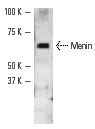
Western blot analysis of Menin expression in K-562 nuclear extract.| Product Name | Menin Antibody (H-300) |
|---|---|
| Antibody Type | Primary Antibodies |
| Antigen Alias | epitope corresponding to amino acids 1-300 mapping at the N-terminus of Menin of human origin |
| Modification Notes | Menin (multiple endocrine neoplasia I, MEN1, MEAI, SCG2) is a nuclear tumor suppressor that is mutated in patients with multiple endocrine neoplasia type I (MEN1). Menin can activate the transcription of differentiation-regulating genes by covalent histone modification. In osteoblasts, the interaction of menin and the TGF∫eta/Smad3 pathway negatively regulates BMP2/Smad1/5- and Runx2-dependent transcription activities leading to inhibition of late-stage differentiation. Menin regulates the expression of IGFBP-2 by influencing the IGFBP-2 promoter. Ectopic overexpression of menin via adenoviruses induces apoptosis in murine embryonic fibroblasts in a Bax/Bak-dependent manner. Two mRNA exist and two variants of the shorter mRNA have alternative splicing that changes the CDS. Five variants where alternative splicing takes place in the 5' UTR have been identified. |
| Clonality | Polyclonal |
|---|---|
| Isotype | IgG |
| Host Species | Rabbit |
| Tested Applications | WBIPIFELISA |
| recommended for detection of Menin of mouse, rat and human origin by WB, IP, IF and ELISA also reactive with additional species, including equine, canine, bovine and porcine: |
|
| Species Reactivity | HumanMouseRat |
| Concentration | 1mg/ml |
| Purification | Affinity purified |
| Alternative Names | epitope corresponding to amino acids 1-300 mapping at the N-terminus of Menin of human origin |
|---|---|
| Tissue Specificity | epitope corresponding to amino acids 1-300 mapping at the N-terminus of Menin of human origin |
| Entrez Gene | 4221 |
|---|
Application
Western blot analysis of Menin expression in K-562 nuclear extract.| Application Notes | recommended for detection of Menin of mouse, rat and human origin by WB, IP, IF and ELISA also reactive with additional species, including equine, canine, bovine and porcine: |
|---|
| Form | Liquid |
|---|---|
| Storage Instructions | For short-term storage, store at 4° C. For long-term storage, aliquot and store at -20ºC or below. Avoid multiple freeze-thaw cycles. |
| Storage Buffer | phosphate buffered saline , pH 7.4, 150mM NaCl, 0.02% sodium azide and 50% glycerol. |


