Application
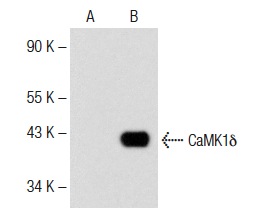
Western blot analysis of CaMK1δ expression in non-transfected: (A) and human CaMK1δ transfected: (B) 293T whole cell lysates.| Product Name | CaMKIδ Antibody (H-67) |
|---|---|
| Antibody Type | Primary Antibodies |
| Antigen Alias | epitope corresponding to amino acids 319-385 mapping at the C-terminus of CaMKIδ of human origin |
| Modification Notes | The Ca2+/calmodulin-dependent protein kinases (CaMKs) comprise a structurally related subfamily of serine/threonine kinases. CaMKI∂ (Calcium/calmodulin-dependent protein kinase type 1∂), also known as CKLiK or CaM-K1, is a 385 amino acid protein that localizes to both the nucleus and the cytoplasm and contains one protein kinase domain. Expressed in a variety of tissues with higher expression in polymorphonuclear leukocytes, CaMKI∂ functions to catalyze the ATP-dependent phosphorylation of target proteins and is thought to regulate calcium-mediated granulocyte function via a calcium-triggered signaling cascade. CaMKI∂ is activated by CaM, which binds to and induces a conformational change in CaMKI∂, thereby allowing CaMKKå and CaMKK∫ to phosphorylate and, subsequently activate CaMKI∂. Nucleotide polymorphisms in the gene encoding CaMKI∂ may increase susceptibility to type 2 diabetes. Two isoforms of CaMK1∂ exist due to alternative splicing events. |
| Clonality | Polyclonal |
|---|---|
| Isotype | IgG |
| Host Species | Rabbit |
| Tested Applications | WBIPIFELISA |
| recommended for detection of CaMKIδ of mouse, rat and human origin by WB, IP, IF and ELISA also reactive with additional species, including equine, canine, bovine and porcine: |
|
| Species Reactivity | HumanMouseRat |
| Concentration | 1mg/ml |
| Purification | Affinity purified |
| Alternative Names | epitope corresponding to amino acids 319-385 mapping at the C-terminus of CaMKI&delta of human origin |
|---|---|
| Tissue Specificity | epitope corresponding to amino acids 319-385 mapping at the C-terminus of CaMKIδ of human origin |
| Entrez Gene | 57118 |
|---|
Application
Western blot analysis of CaMK1δ expression in non-transfected: (A) and human CaMK1δ transfected: (B) 293T whole cell lysates.| Application Notes | recommended for detection of CaMKIδ of mouse, rat and human origin by WB, IP, IF and ELISA also reactive with additional species, including equine, canine, bovine and porcine: |
|---|
| Form | Liquid |
|---|---|
| Storage Instructions | For short-term storage, store at 4° C. For long-term storage, aliquot and store at -20ºC or below. Avoid multiple freeze-thaw cycles. |
| Storage Buffer | phosphate buffered saline , pH 7.4, 150mM NaCl, 0.02% sodium azide and 50% glycerol. |


