Application
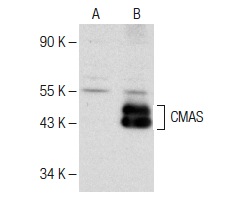
Western blot analysis of CMAS expression in non-transfected: (A) and mouse CMAS transfected: (B) 293T whole cell lysates.Application
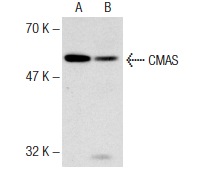
Western blot analysis of CMAS expression in K-562 nuclear extract (A) and HeLa whole cell lysate (B).| Product Name | CMAS Antibody (H-264) |
|---|---|
| Antibody Type | Primary Antibodies |
| Antigen Alias | epitope corresponding to amino acids 26-289 mapping near the N-terminus of CMAS of human origin |
| Modification Notes | CMAS (cytidine monophosphate N-acetylneuraminic acid synthetase), also known as CMP-NeuNAc synthetase or CMP-sialic acid sythetase, is a ubiquitously expressed 434 amino acid protein involved in sialic acid metabolism. Localizing to the nucleus, the evolutionarily conserved enzyme CMAS functions as a homotetramer and catalyzes the production of cytidine 5’-monophosphate N-acetylneuraminic acid (CMP-NeuNAc) from N-acetylneuraminic acid and CTP. The generation of CMP-NeuNAc is an important reaction because CMP-NeuNAc is an essential donor substrate used by sialyltransferases for the addition of sialic acid to hydroxyl groups at the terminal end of glycoproteins, polysaccharides and glycolipids. Proteins with this post-translational modification play an important role in the development, structure and function of animal tissues. |
| Clonality | Polyclonal |
|---|---|
| Isotype | IgG |
| Host Species | Rabbit |
| Tested Applications | WBIPIFELISA |
| recommended for detection of CMAS of mouse, rat and human origin by WB, IP, IF and ELISA also reactive with additional species, including equine, canine, bovine and porcine: |
|
| Species Reactivity | HumanMouseRat |
| Concentration | 1mg/ml |
| Purification | Affinity purified |
| Alternative Names | epitope corresponding to amino acids 26-289 mapping near the N-terminus of CMAS of human origin |
|---|---|
| Tissue Specificity | epitope corresponding to amino acids 26-289 mapping near the N-terminus of CMAS of human origin |
Application
Western blot analysis of CMAS expression in non-transfected: (A) and mouse CMAS transfected: (B) 293T whole cell lysates.
Application
Western blot analysis of CMAS expression in K-562 nuclear extract (A) and HeLa whole cell lysate (B).| Application Notes | recommended for detection of CMAS of mouse, rat and human origin by WB, IP, IF and ELISA also reactive with additional species, including equine, canine, bovine and porcine: |
|---|
| Form | Liquid |
|---|---|
| Storage Instructions | For short-term storage, store at 4° C. For long-term storage, aliquot and store at -20ºC or below. Avoid multiple freeze-thaw cycles. |
| Storage Buffer | phosphate buffered saline , pH 7.4, 150mM NaCl, 0.02% sodium azide and 50% glycerol. |


