Application
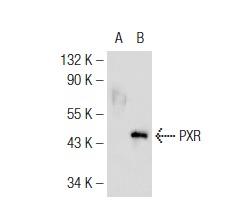
Western blot analysis of PXR expression in non-transfected: (A) and human PXR transfected: (B) 293 whole cell lysates.| Product Name | PXR Antibody (H-160) AC |
|---|---|
| Antibody Type | Primary Antibodies |
| Antigen Alias | epitope corresponding to amino acids 101-260 of PXR.1 of human origin |
| Modification Notes | Steroid hormones function as signaling molecules by diffusing into cells and interacting with specific intracellular receptors to regulate gene expression. This superfamily of receptors includes both steroid and nonsteroid receptors. Like many nonsteroid hormone receptors, PXR (Pregnane X Receptor) binds as a heterodimer with RXR to a DNA sequence typical of a nonsteroid hormone receptor; however, PXR is activated by several steroids, such as naturally occurring pregnanes and synthetic glucocorticoids and anti- glucocorticoids. PXR exists as two alternatively spliced isoforms, PXR.1 and PXR.2. PXR is thought to define a novel steroid hormone signaling pathway that may account for some of the effects of synthetic glucocorticoids and antiglucocorticoids that are not mediated through the classical glucocorticoid receptor signaling pathway. |
| Clonality | Polyclonal |
|---|---|
| Isotype | IgG |
| Host Species | Rabbit |
| Tested Applications | WBIPIFELISAGSChIP |
| recommended for detection of PXR.1 and PXR.2 of mouse, rat and human origin by WB, IP, IF and ELISA also reactive with additional species, including equine: |
|
| Species Reactivity | HumanMouseRat |
| Concentration | 1mg/ml |
| Purification | Affinity purified |
| Alternative Names | epitope corresponding to amino acids 101-260 of PXR.1 of human origin |
|---|---|
| Tissue Specificity | epitope corresponding to amino acids 101-260 of PXR.1 of human origin |
| Entrez Gene | 8856 |
|---|
Application
Western blot analysis of PXR expression in non-transfected: (A) and human PXR transfected: (B) 293 whole cell lysates.| Application Notes | recommended for detection of PXR.1 and PXR.2 of mouse, rat and human origin by WB, IP, IF and ELISA also reactive with additional species, including equine: |
|---|
| Form | Liquid |
|---|---|
| Storage Instructions | For short-term storage, store at 4° C. For long-term storage, aliquot and store at -20ºC or below. Avoid multiple freeze-thaw cycles. |
| Storage Buffer | phosphate buffered saline , pH 7.4, 150mM NaCl, 0.02% sodium azide and 50% glycerol. |


