Application
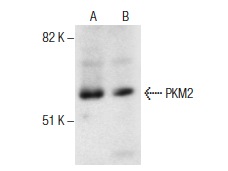
Western blot analysis of PKM2 expression in U-251 MG (A) and A549 (B) whole cell lysates.| Product Name | PKM2 Antibody (H-59) |
|---|---|
| Antibody Type | Primary Antibodies |
| Antigen Alias | epitope corresponding to amino acids 455-513 mapping near the C-terminus of PKM2 of human origin |
| Modification Notes | In mammals, four different isoenzymes exist for pyruvate kinase. Based on their tissue distribution, the isoenzymes are designated L-type (for predominant expression in the liver), R-type (for predominant expression in red blood cells), M1-type (for predominant expression in muscle, brain and heart) and M2-type (for predominant expression in fetal tissues). Pyruvate kinases are responsible for catalyzing the final step in glycolysis: the conversion of phosphoenolpyruvate to pyruvate with the coinciding generation of ATP. The PKM2 (pyruvate kinase, muscle) gene encodes the M1- and M2-type isoenzymes through alternative splicing events. Both M1- and M2-type isoforms exists as tetramers and are stimulated by fructose 1,6-bisphosphate. In addition, both isoforms exhibit thyroid hormone binding activity and may be referred to as CTHBP (cytosolic thyroid hormone-binding protein) or THBP1. The M2-type isoform also interacts with Oct-4 via its C-terminal domain, functioning to enhance Oct-4 transcriptional activity. |
| Clonality | Polyclonal |
|---|---|
| Isotype | IgG |
| Host Species | Rabbit |
| Tested Applications | WBIPIFELISA |
| recommended for detection of PKM2 of mouse, rat and human origin by WB, IP, IF and ELISA also reactive with additional species, including equine, canine, bovine and porcine: |
|
| Species Reactivity | HumanMouseRat |
| Concentration | 1mg/ml |
| Purification | Affinity purified |
| Alternative Names | epitope corresponding to amino acids 455-513 mapping near the C-terminus of PKM2 of human origin |
|---|---|
| Tissue Specificity | epitope corresponding to amino acids 455-513 mapping near the C-terminus of PKM2 of human origin |
| Entrez Gene | 5315 |
|---|
Application
Western blot analysis of PKM2 expression in U-251 MG (A) and A549 (B) whole cell lysates.| Application Notes | recommended for detection of PKM2 of mouse, rat and human origin by WB, IP, IF and ELISA also reactive with additional species, including equine, canine, bovine and porcine: |
|---|
| Form | Liquid |
|---|---|
| Storage Instructions | For short-term storage, store at 4° C. For long-term storage, aliquot and store at -20ºC or below. Avoid multiple freeze-thaw cycles. |
| Storage Buffer | phosphate buffered saline , pH 7.4, 150mM NaCl, 0.02% sodium azide and 50% glycerol. |


