Application
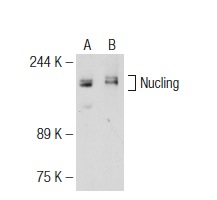
Western blot analysis of Nucling expression in 293T (A) and WI 38 (B) whole cell lysates.Application
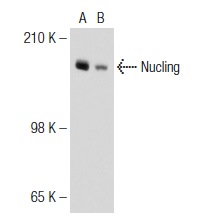
Western blot analysis of Nucling expression in HeLa (A) and MIA PaCa-2 (B) whole cell lysates.| Product Name | Nucling Antibody (N-13) |
|---|---|
| Antibody Type | Primary Antibodies |
| Antigen Alias | epitope mapping near the N-terminus of Nucling of human origin |
| Modification Notes | Nucling, also known as UACA (uveal autoantigen with coiled-coil domains and ankyrin repeats) and KIAA1561, is a 1,416 amino acid nuclear and cytoplasmic protein. Up-regulated after TSH-stimulation, Nucling is a component of the apoptosome complex, whose other components include Apaf-1 and caspase-9. Nucling interacts directly with Apaf-1 and regulates it’s redistribution to the nucleus following proapoptotic stress. Nucling also plays a role in the promotion of apoptosis by the galectin-3 down-regulation, apoptosome up-regulation and NF˚B inactivation pathways. Nucling also interacts with ARF6, which may modulate cell shape and motility following injury. Nucling contains six ANK repeats and is expressed highly in kidney, heart, pancreas and skeletal muscle. Nucling is a potential target autoantigen in Behcet disease (BD), Vogt-Koyanagi-Harada (VKH) and sarcoidosis, which cause different types of panuevitis. |
| Clonality | Polyclonal |
|---|---|
| Isotype | IgG |
| Host Species | Rabbit |
| Tested Applications | WBIPIFELISA |
| recommended for detection of Nucling of mouse, rat and human origin by WB, IP, IF and ELISA also reactive with additional species, including equine, canine, bovine and porcine: |
|
| Species Reactivity | HumanMouseRat |
| Concentration | 1mg/ml |
| Purification | Affinity purified |
| Alternative Names | epitope mapping near the N-terminus of Nucling of human origin |
|---|---|
| Tissue Specificity | epitope mapping near the N-terminus of Nucling of human origin |
| Entrez Gene | 55075 |
|---|
Application
Western blot analysis of Nucling expression in 293T (A) and WI 38 (B) whole cell lysates.
Application
Western blot analysis of Nucling expression in HeLa (A) and MIA PaCa-2 (B) whole cell lysates.| Application Notes | recommended for detection of Nucling of mouse, rat and human origin by WB, IP, IF and ELISA also reactive with additional species, including equine, canine, bovine and porcine: |
|---|
| Form | Liquid |
|---|---|
| Storage Instructions | For short-term storage, store at 4° C. For long-term storage, aliquot and store at -20ºC or below. Avoid multiple freeze-thaw cycles. |
| Storage Buffer | phosphate buffered saline , pH 7.4, 150mM NaCl, 0.02% sodium azide and 50% glycerol. |


