Application
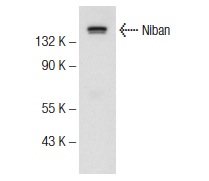
Western blot analysis of Niban expression in HS 181.Tes whole cell lysate.| Product Name | Niban Antibody (H-240) |
|---|---|
| Antibody Type | Primary Antibodies |
| Antigen Alias | epitope corresponding to amino acids 1-240 mapping at the N-terminus of Niban of human origin |
| Modification Notes | Meaning “second” in Japanese, Niban, also known as FAM129A and Cell growth-inhibiting gene 39 protein, is a 928 amino acid cytoplasmic protein that regulates phosphoryation of many proteins that are involved in translation regulation, such as eIF2å, 4E-BP1 and p70 S6 kinase å. Since it ultimately functions as as activator of proteins, Niban has been implicated as a tumor marker for renal carcinoma, thyroid cancer and head and neck squamous cell carcinoma. Endoplasmic reticular stress induced in Niban knockout mice leads to upregulation of eIF2å and decreased phosphorylation of p70 S6 kinase å and 4E-BP1. Niban suppression eventually leads to apoptosis, therefore illustrating its involvement in the modulation of cell death signaling by regulating translation. |
| Clonality | Polyclonal |
|---|---|
| Isotype | IgG |
| Host Species | Rabbit |
| Tested Applications | WBIPIFELISA |
| recommended for detection of Niban of mouse, rat and human origin by WB, IP, IF and ELISA also reactive with additional species, including canine, bovine and porcine: |
|
| Species Reactivity | HumanMouseRat |
| Concentration | 1mg/ml |
| Purification | Affinity purified |
| Alternative Names | epitope corresponding to amino acids 1-240 mapping at the N-terminus of Niban of human origin |
|---|---|
| Tissue Specificity | epitope corresponding to amino acids 1-240 mapping at the N-terminus of Niban of human origin |
| Entrez Gene | 116496 |
|---|
Application
Western blot analysis of Niban expression in HS 181.Tes whole cell lysate.| Application Notes | recommended for detection of Niban of mouse, rat and human origin by WB, IP, IF and ELISA also reactive with additional species, including canine, bovine and porcine: |
|---|
| Form | Liquid |
|---|---|
| Storage Instructions | For short-term storage, store at 4° C. For long-term storage, aliquot and store at -20ºC or below. Avoid multiple freeze-thaw cycles. |
| Storage Buffer | phosphate buffered saline , pH 7.4, 150mM NaCl, 0.02% sodium azide and 50% glycerol. |


